

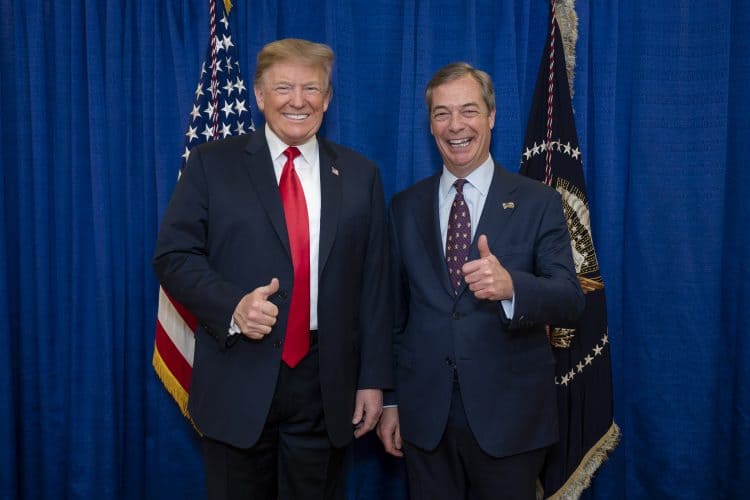
It no longer requires speculation to imagine what a Nigel Farage-led Britain might look like. We have already seen it play out – loudly, chaotically, and painfully – across the Atlantic.
Under Donald Trump, the United States has become a case study in economic recklessness, political opportunism, and a governing philosophy that prioritises spectacle over stability. And if we are honest with ourselves, the parallels with Farage are not just striking, they are alarming.
Take the economy. Before Trump’s latest wave of tariffs, inflation in the United States had been on a downward trajectory. There were signs – fragile, but real – that price pressures were easing and that ordinary Americans might finally catch their breath after years of rising costs.
Then came the tariffs.
In a move framed as economic patriotism but executed with blunt force, Trump’s trade policies triggered a sharp reversal. Inflation surged again, wiping out months of progress. The cost of everyday essentials, from fuel to food, began climbing once more, hitting working families hardest. What had been a tentative recovery became yet another squeeze.
This is not abstract economics. It is the weekly shop. It is the price at the petrol pump. It is the quiet anxiety of households recalculating budgets that no longer stretch far enough.
And it does not stop there.
The wider economy is now showing clear signs of distress. Consumer confidence has plummeted. Markets have reacted with volatility. The shockwaves of geopolitical brinkmanship – particularly the escalation of tensions with Iran – have only compounded the damage. What we are witnessing is not a resilient economy weathering a storm, but one being actively destabilised by the decisions of its own leadership.
Yet, as ever, the pain is not evenly shared.
For the wealthy, moments of crisis often present opportunity. Those with the means to short markets or shift vast sums into speculative assets like cryptocurrency can not only shield themselves from the fallout, but profit from it. Meanwhile, ordinary people – those without financial buffers or insider access – are left to absorb the consequences.
It is a tale as old as inequality itself: when the system falters, the rich get richer, and everyone else is left behind.
This is where the comparison with Nigel Farage becomes impossible to ignore.
Farage, like Trump, has built a political brand on disruption without responsibility. He positions himself as a champion of “ordinary people,” yet operates comfortably within the circles of wealth and privilege that insulate him from the very hardships he claims to fight against. Rising fuel prices? Cancelled flights? Soaring grocery bills? These are irritations at most for millionaires. For millions of others, they are life-altering.
There is a fundamental disconnect here, one that cannot be papered over with slogans or soundbites.
Because governing is not the same as campaigning. It is not about provocation or personality. It is about consequences.
And the consequences of Trump’s America are now plain to see: economic instability, deepening inequality, and a political culture that thrives on division while neglecting the material realities of people’s lives.
The question facing Britain is whether we are willing to learn from that example – or repeat it.
Reform UK may package itself as a fresh alternative, but its ideological DNA is unmistakably familiar. The same disdain for expertise. The same appetite for risk. The same tendency to frame complex problems as simple battles between “the people” and shadowy elites, while quietly aligning with the interests of the wealthy.
We should not be fooled.
What is unfolding in the United States is not an isolated phenomenon. It is a warning.
A warning of what happens when populism meets power without preparation. When ideology overrides evidence. When leaders gamble with economies and livelihoods in pursuit of political theatre.
In the carnage of the Trump administration, we have been given a preview – a glimpse of the road Britain could take.
The question is not whether we recognise it.
The question is whether we choose to follow it.
Are we really sure we want more of this?