

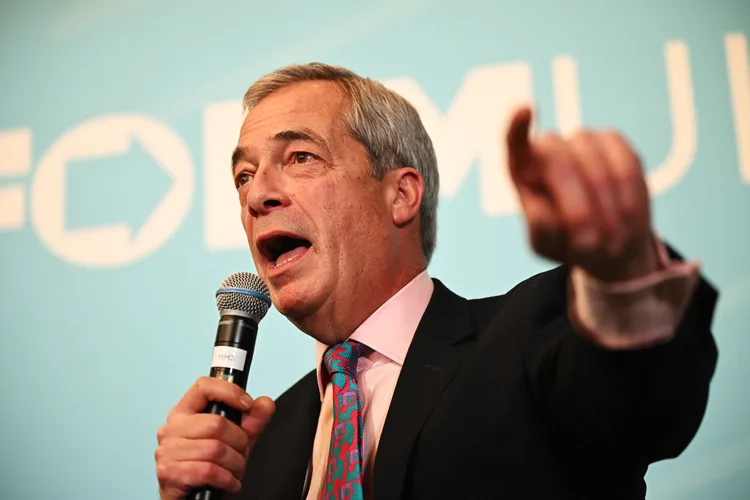
Reform UK has become the most referenced oppositional party on the BBC and ITV’s major news coverage, new research has found.
Nigel Farage’s party have dominated polling all year, and as a result have seen the amount of coverage and attention they get vastly increase.
At the same time though, they only have five MPs and some reckon Reform are getting a disproportionate amount of coverage as a result.
READ NEXT: Tommy Robinson takes legal action against Nigel Farage over ‘defamatory claims’
And if it feels like you’ve heard more from Reform than the likes of the Lib Dems (72 MPs) and the Tories (119 MPs) in the media, then it turns out you’re right.
New analysis from Cardiff University has found that in September 2025, Reform became the most referenced oppositional party on the BBC News at Ten and ITV News at Ten.
The research examined 271 days of BBC News at Ten and 256 days of ITV News at Ten between 1 January 2025 and 30 September 2025.
In total, it analysed 563 references to parties and their leaders (338 BBC and 225 ITV), the topics they appeared in and whether a party was leading coverage (the dominant focus of a story) or responding to an issue, event or a rival party.
The team from Cardiff’s School of Journalism, Media and Culture found that over the year, the Tories were the most referenced party over the year. They were mentioned in 258 stories across the two flagship News at Ten programmes, with Reform getting 157 mentions and the Lib Dems 86 references.
But in September 2025, Reform (37 references) overtook the Conservatives (25) as the most referenced opposition party on both the BBC news at Ten and ITV News at Ten. Coverage of Reform UK in September increased with a focus on stories about immigration and asylum along with the party’s conference, the analysis found.
Other key findings were:
- Nigel Farage was the most referenced party leader on ITV News at Ten (49), followed by the Conservative’s Kemi Badenoch (33), and the Liberal Democrats’ Ed Davey (10). On BBC News at Ten, Kemi Badenoch (57) was the most referenced party leader, followed by Nigel Farage (47) and Ed Davey (20).
- Reform UK received three times as many references as the Liberal Democrats on ITV News at Ten, and 1.36x as many references as the Liberal Democrats on BBC News at Ten.
- Reform UK was the dominant party in more than twice as many stories as the Tories and just under four times more stories than the Lib Dems. On the BBC News at Ten, Reform UK was the main focus in 26 items, compared to the Conservatives’ 14 items, and the Liberal Democrats’ 8 items. On ITV, Reform UK was the dominant party in 25 items, compared to the Conservatives’ 11 items, and the Liberal Democrats’ 5 items.
- The Greens received very little coverage despite their popularity in the polls. Most of their coverage was in the context of the local elections and the party’s 2025 leadership contest. Even then, neither BBC nor ITV News at Ten covered the announcement or build-up to the Green Party leadership election in the summer. Both bulletins only covered the result on September 2.
- Despite the SNP being the party in government in Scotland and having nine MPs, it received limited airtime in TV news, with a large proportion of coverage related to Operation Branchfoot and the embezzlement scandal that led Nicola Sturgeon’s resignation as First Minister. There was “scant coverage of the current SNP government’s policy agenda in Scotland or its members in Westminster”, researchers said.
Professor Stepehn Cushion, Director of Research Development and Environment and Impact at Cardiff Uni’s journalism school, said: “While broadcasters have been accused of giving Reform UK a ‘disproportionate’ amount of airtime, within Ofcom’s impartiality rules there is no precise benchmark of what is proportionate. Broadcasters have considerable freedom to make editorial judgements about the airtime parties receive based on a range of criteria. At present they appear to be applying greater weight to trends in opinion poll data and which party is setting the political weather, rather than number of MPs a party has or its total vote share at the last general election.
“In a more multi-party system, the competition for airtime will only intensify. While it is not always easy to feature all parties in TV and radio programming, broadcasters need to be transparent to their audiences about how they allocate airtime. The public need to understand how broadcasters interpret the impartiality of political news. As the devolved elections in Scotland and Wales approach, broadcasters will again come under pressure to explain how they weight coverage in a crowded field of political parties.”