

In recent months, the British stage has once again been actively exploring the relationship between the individual and power. Productions such as I’m Sorry, Prime Minister, running from January to May at the Apollo Theatre, engage with contemporary British politics and bureaucracy. But some productions reach beyond any single country or historical moment. Portent, Anastasia Nikolaeva’s political satire about the government of a totalitarian state, is one of them. The production made its debut on London’s independent stage at the Court Theatre Training Company, where, unlike commercial theatres, the most uncomfortable questions about power, accountability, and the future of society can be asked more freely. That is exactly what the play accomplishes.
The action unfolds inside a cabinet room, behind whose closed doors gather the people who nominally hold power over the country. As the plot develops, however, it becomes clear that they control far less than they claim, or rather, almost nothing at all, yet they continue to perform the illusion of governance and go through the motions of decision-making. Their decisions are entirely disconnected from real problems: the state is drifting toward crisis, war has become the background noise of everyday life, corruption has seeped into every level of the system, and a genuine catastrophe is approaching. These themes inevitably evoke associations with the present day, yet the playwright deliberately avoids direct political references. This keeps the production from becoming a commentary on specific events and gives it a more universal resonance: every audience member will recognise in it their own story, their own fears, their own country.
The play balances masterfully between satire and drama. On one hand, we are presented with an almost grotesque world of officials who continue to defend the system even as it visibly crumbles around them. On the other, the playwright never lets the characters become caricatures. Behind the titles, ranks, and political slogans are people with their own fears, attachments, and inner contradictions. State crises are mirrored in family conflicts, professional ambitions collide with personal loyalties, and conversations about duty and responsibility gradually give way to conversations about love, loneliness, and fear. The cabinet room, in turn, becomes a space of deeply human drama.
Some of the dramatic moves can be anticipated early on: we understand fairly quickly that a power built on fear and moral compromise cannot sustain itself indefinitely. But what matters here is not the ending itself, so much as the path toward it. The production does not examine the moment a system collapses but rather the process of its internal decay, slow, painful, and strikingly human.
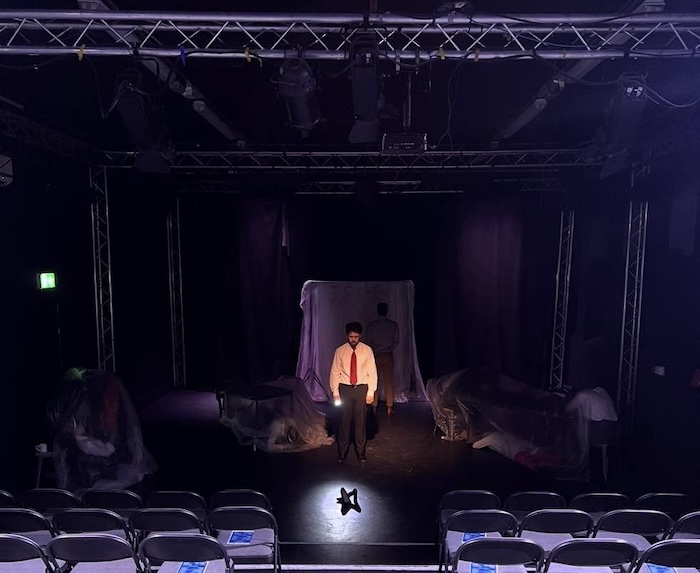
Non-verbal modes of expression carry particular weight in this production. Among them are dialogues built on indirection and subtext, through which the characters’ emotions are conveyed through the tension between words rather than the words themselves. The musical score creates a dense atmosphere and amplifies the emotional charge of key scenes, while the work with gesture and expression fills in what the text leaves unsaid. The visual design is equally vital: designer Olya Lysenko has conceived the costumes and set not only to define the action’s space but also to imbue it with an additional layer of significance.
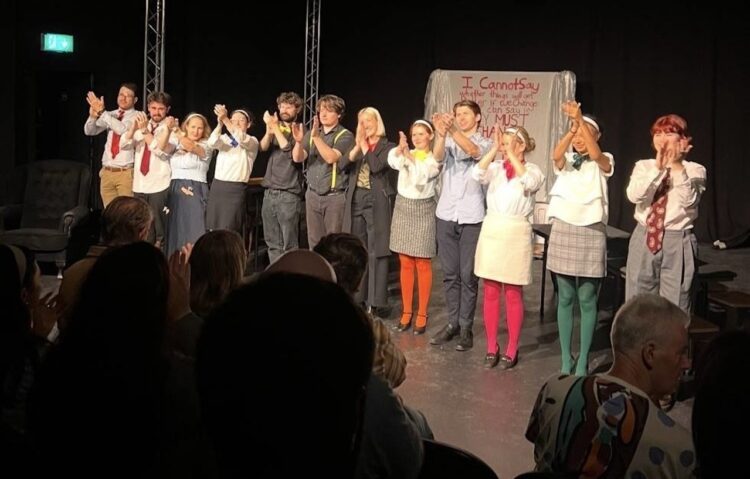
The final scene deepens this sense of layered complexity. A song plays as a banner unfurls behind the characters, its inscription printed in red, which in this context reads as a mark of bloodshed and a memorial to the system’s victims. The words on the banner function as a direct, almost journalistic statement: “I сannot say whether things will get better if we change; what I can say is THEY MUST CHANGE if they are to get BETTER”.
This line closes the play, leaving the audience in profound reflection. Can the historical cycle be broken? Can power voluntarily relinquish itself? And at what point does personal responsibility cease to be a private choice and become a question of collective futures?
The title of the production translates as “omen,” and that word holds its central meaning. This is a warning about what happens when those in power make decisions without thinking about the consequences. The narrative presented on stage resonates not merely as a recounting of the past, but as a disquieting reflection on the present and a cautionary glimpse into a future destined to repeat itself. This cycle can only be broken if individuals are willing to critically reevaluate the underlying principles that govern state power.