

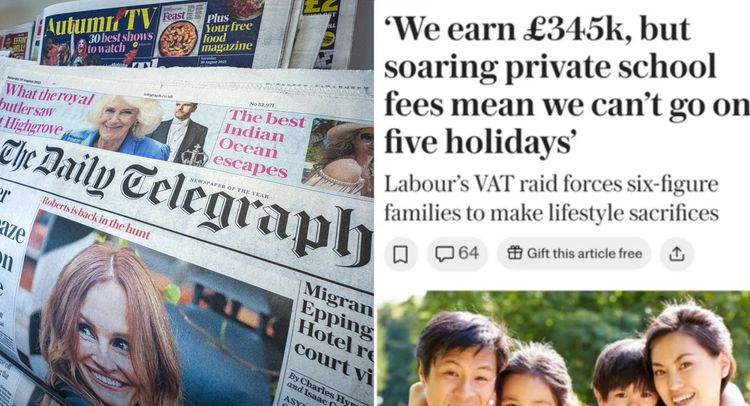
The Daily Telegraph has issued a remarkable correction for publishing an private school fees sob story last year that turned out to be entirely fabricated.
The article, headlined “We earn £345k, but soaring private school fees mean we can’t go on five holidays” and written by a freelance journalist, was published in June 2025 before being quickly retracted by the paper.
Whilst the piece was based on a real interview, an investigation by the Press Gazette has found that the source gave the reporter a fake name and duped them with the tale.
Now, the Telegraph has issued a correction about the article, which was described as “incredible” by commentator and academic Gerry Hassan.
You can find press watchdog IPSO’s full report on the piece below – which is definitely worth reading in full – but perhaps the most remarkable takeaway from it is that the Telegraph declines to give any information about how the article came to be published.
The Telegraph claimed this information “related to internal and confidential investigations.”
READ NEXT: Britain is on the ‘cusp of an economic boom,’ Telegraph predicts
The publication said they believed they had “already taken the appropriate and necessary steps to remedy the breach” of the Editors’ Code of Practice with an apology published online 24 days after the article was initially published.
IPSO said it was an “unusual case where a publication had undertaken internal inquiries in response to complaints and concluded that it could not verify any of the details of a published article.”
“This called into question the accuracy of the entire article, which had been presented as an illustrative example of the real-world impact of a controversial government policy,” the watchdog continued.
You can read the full IPSO finding below:
1. Ian Fraser complained to the Independent Press Standards Organisation that Telegraph.co.uk breached Clause 1 (Accuracy) of the Editors’ Code of Practice in an article headlined “We earn £345k, but soaring private school fees mean we can’t go on five holidays”, published on 25 May 2025.
2. The complainant was one of a number of individuals who raised concerns about the article; in line with IPSO’s usual procedures, he was selected as IPSO’s lead complainant for the purpose of investigating the complaint.
3. The article – which appeared online only – reported on the impact increases in private school fees had had on a named couple and their three children. The article included several photographs of a couple, and of children. The photographs were captioned: “[The couple’s] children’s school fees went from £55,000 to £70,000 almost overnight”; and “[The father] wants to give his children the best possible education he can – he feels a private school is the best way to do that”.
4. The article reported that the father of the family was 38, and that the family were “originally from Singapore but also lived in New York for 20 years”. It also reported that they had gardener, who “used to come twice a month, but then he increased his costs from £230 a year to £245 a year”.
5. The complainant said that the article was inaccurate in breach of Clause 1 because he did not believe the family referenced in the article existed. He said this was for several reasons. Firstly, he said that the photographs of the family included in the article were stock photographs from 2012 and 2014. The complainant said the images were sourced from picture agencies and provided links to the photo agency websites to support his position.
6. The complainant also said: the timeline given in the article for the couple’s moves to New York and the UK did not make sense; there was no record online of the family; there was no indication in the article of where the family lived; and that it was implausible that the family would have “baulked” at paying their gardener an additional £15 per year.
7. The publication removed the article seven hours after its initial publication and prior to being made aware of the complaint.
8. On 18 June, nineteen days after the publication was made aware of the complaint, it published a standalone apology which read:
“On 25th May we published an online article ‘We earn £345k, but soaring private school fees mean we can’t go on five holidays’ which included stock photographs and not, as the article indicated, images of the family referred to in the article. In addition, we have not been able to verify the details published.
There has been public speculation the story was created using Artificial Intelligence; this is not the case. We apologise to our readers for these errors which should not have occurred.”
9. A link to this apology appeared on the publication’s homepage for 24 hours. The apology was also published in its online Corrections & Clarifications column, which was permanently linked to at the bottom of its homepage. A link to the apology also appeared on the publication’s social media feed.
10. On the same day, the publication wrote to the complainant and said the following:
“We have established that contrary to the impression given, the images shown were stock photographs and not pictures of the family the subject [sic] of the article. We have also not been able to independently verify the details published.
We are aware of speculation that the story was created using Artificial Intelligence; this is not the case. We apologise to you and have publicly apologised to all our readers for having published an article that did not meet the standards we and you expect from The Telegraph. We have reviewed our procedures to seek to avoid such an error ever happening again.”
11. During IPSO’s investigation, while the publication accepted it had not taken due care over the accuracy of the article, it said it was satisfied any error had been rectified promptly and prominently. It said the article was “expunged” from its website and social media accounts as soon as the issues in question arose.
It added that it had become clear shortly after publication that there was an issue with the images, which had led to an internal investigation. Following this, “the team lost confidence in the article as a whole and immediately removed it from online”. It said the investigation revealed that the issues which arose stemmed from a failure to make pre-publication checks.
12. As a result of this, the publication said that those involved in the article had been advised that “significant mistakes” had been made, and a reminder of best practice had been issued to all sections which dealt with case studies. It also said that in-person sessions were held with members of the relevant section “to reinforce not only what had gone wrong but the lessons that had to be learned and a reminder of best practice in respect of case studies.”
13. In relation to the inaccuracies regarding the gardener, the publication said that this came about due to a subediting error and did not accord with what the case study had told the journalist.
14. The complainant said the apology was published 24 days after the article was initially published, which he did not consider to be sufficiently prompt. He also did not consider the apology was sufficiently prominent, as it appeared online only. Further to this, he said that the apology did not explain how what appeared to be a “completely fabricated article” had come about.
15. The publication said that the delay in publishing the apology was due to the fact it had conducted an “in depth and wide-ranging internal investigation” which included “interviewing 9 individuals”, some of whom were outside its organisation. The publication said that the investigation was further slowed as it may have raised potential legal and HR issues stemming from the publication of the article. The publication did not accept that the delay was an undue one and said that, in the circumstances, the apology had been offered promptly.
16. During IPSO’s investigation, it asked the publication whether it could detail how the article had come to be published. The publication said it was not in a position to provide IPSO with further information about how the article came to be published, given this information related to internal and confidential investigations.
It added that, given it had already published an apology, it considered it had already taken the appropriate and necessary steps to remedy the breach of the Code, and declined to provide further information for the benefit of the IPSO’s Complaints Committee beyond what it had previously set out.
17. This was an unusual case where a publication had undertaken internal inquiries in response to complaints and concluded that it could not verify any of the details of a published article. This called into question the accuracy of the entire article, which had been presented as an illustrative example of the real-world impact of a controversial government policy. This had resulted in the article being removed in its entirety hours after its publication.
18. Citing obligations of confidentiality, the publication had not provided an account for how the article – which it had said, in its apology, it had not been able to “independently verify” – had been published.
19. Publications are expected to demonstrate what steps they have taken not to publish inaccurate information – this shows compliance with the Editors’ Code, and a commitment to high editorial standards.
The publication had not provided any evidence of adequate pre-publication checks, and within hours of publication it had evidently been able to establish that it could not stand by the story – leading to the decision to withdraw it. In these circumstances, the Committee found that there was a serious failure to take care not to publish inaccurate information and a breach of Clause 1 (i).
20. Based on the limited information provided by the publication, the Committee was satisfied that the article was inaccurate on at least two points: the gardener’s pay, which the publication had attributed to a subediting error, and the presentation of stock images as images of the family featured in the story.
21. However, given that the publication had indicated that it had lost confidence in the article as a whole and there was no evidence from any source to corroborate the existence of the family or accuracy of the information provided about their circumstances, the Committee considered that there was sufficient basis to find that the article was significantly inaccurate and required correction.
22. The Committee therefore turned to the question of whether the apology published by the publication met the terms of Clause 1 (ii), which requires that significantly inaccurate information is corrected, promptly and with due prominence, and where appropriate, an apology published.
23. The Committee considered the adequacy of the correction and apology published by the publication. The Committee welcomed that it included an apology, which was appropriate given the extent of the publication’s inability to stand by the story. It also contained a clear acknowledgment that the family shown in the stock images was not the family referenced in the case study.
However, the apology did not set out how the remainder of the article was inaccurate. The Committee acknowledged that, given the unusual circumstances of the case, the publication could not identify each specific inaccuracy in the article and correct it; this followed from its earlier failure to take care. Nonetheless, the consequence was that the publication could not verify any of the remaining details in the article in a manner which would allow it to adequately correct the record in the manner required by the terms of Clause 1 (ii). Given this, and the extent of the breach, the Committee did not consider that this significantly inaccurate article could be remedied by a correction. There was, therefore, a breach of Clause 1 (ii).
24. The complaint was upheld under Clause 1.
25. As noted above, the Committee did not consider that the publication of a correction was sufficient or appropriate to remedy the breach of the Code in this case, given the extent and seriousness of the breach and the difficulty of clarifying to readers the correct position.
For the same reasons, it also considered that the publication of a further correction and apology was not the appropriate means to provide remedy to the breach. In such circumstances, the Committee considered that the publication of an adjudication was required to remedy the breach of Clause 1.
26. The Committee considered the placement of this adjudication. When considering the prominence of this adjudication, the Committee noted that – notwithstanding the seriousness of the breach – the publication had quickly removed the article and had later published an apology.
It therefore considered that the adjudication should be published online as a standalone article, with a link to this adjudication (including the headline) flagged on the top 50% of the publication’s homepage for 24 hours; it should then be archived in the usual way. A link to the adjudication should also be added to the publication’s published apology.
27. The terms of the adjudication for publication are as follows:
Ian Fraser complained to the Independent Press Standards Organisation that Telegraph.co.uk breached Clause 1 (Accuracy) of the Editors’ Code of Practice in an article headlined “We earn £345k, but soaring private school fees mean we can’t go on five holidays”, published on 25 May 2025.
The complaint was upheld, and IPSO required Telegraph.co.uk to publish this adjudication to remedy the breach of the Code.
The article – which appeared online only – reported on the impact increases in private school fees had had on a named couple and their three children.
The complainant said that the article was inaccurate in breach of Clause 1 because he did not believe the family referenced in the article existed.
While the publication accepted it had not taken due care over the accuracy of the article, it said it was satisfied any error had been rectified promptly and prominently. It said the article was “expunged” from online and from its social media as soon as the issues in question arose.
It added that it had become clear shortly after publication that there was an issue with the images, which had led to an internal investigation. It said the investigation revealed that the issues which arose stemmed from a failure to make pre-publication checks.
On 18 June, the publication published a standalone apology, in which it said it had “not been able to verify the details published”.
Given that the publication had indicated that it had lost confidence in the article as a whole, IPSO considered that, in such circumstances, there was sufficient information before it to find that the article was significantly inaccurate.
Publications are expected to demonstrate what steps they have taken not to publish inaccurate information – this shows compliance with the Editors’ Code, and a commitment to high editorial standards The publication had not provided any evidence of adequate pre-publication checks, and within hours of publication it had evidently been able to establish that it could not stand by the story.
In these circumstances, IPSO found that there was a serious failure to take care not to publish inaccurate information and a breach of Clause 1 (i). The Committee acknowledged that, given the unusual circumstances of the case, the publication could not identify each specific inaccuracy in the article and correct it; this followed from its earlier failure to take care. Nonetheless, the consequence was that the publication could not verify any of the remaining details in the article in a manner which would allow it to adequately correct the record in the manner required by the Code.
IPSO therefore did not consider that the publication of a correction was sufficient or appropriate to remedy the breach of the Code in this case, given the extent and seriousness of the breach and the difficulty of clarifying to readers the correct position. In such circumstances, IPSO required the publication of an adjudication.