
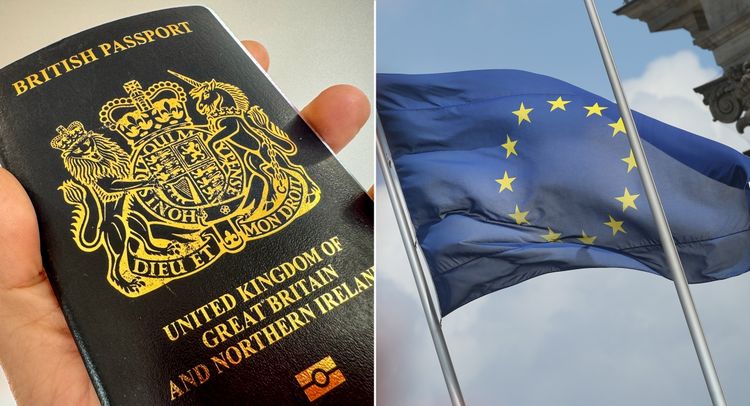
Plans for the EU’s Entry/Exit System (EES) have been in development for almost a decade, after first being proposed by European leaders in 2016.
Although the system was originally expected to be rolled out across the EU by 2022, delays meant it took longer than anticipated, with installations finally beginning to appear in airports towards the end of last year.
As a result, British travellers will soon be required to pay for a visa waiver in order to enter 29 European countries.
What are the EES, ETIAS and when will you have to start paying for your wisa-waiver?
EES stands for Entry/Exit System, and it has already started being introduced in European airports.
This system registers travellers from non-EU countries digitally, each time they cross a border into or out of the EU.
This means that your travel history is stored digitally and that you no longer need passport stamps.
READ NEXT: Number of Europeans with unfavourable view of the US reaches HIGHEST point on record
The aim of this system is to make travelling through airports more efficient and to improve border security.
As a traveller, you are required to register four of your fingerprints and your facial biometrics at the border.
However, you won’t need to do this again for three years, that is unless you get a new passport.
Instead of manual passport stamping, you scan your passport at an automated self-service kiosk at border control.
Only once EES is completely rolled out, that’s when ETIAS, which stands for European Travel Information and Authorisation System, will only come into place.
It is also known as a ‘euro-visa’, as it’s the visa waiver that non-EU citizens will need in order to enter the Schengen zone.
Holders can also stay in European countries for up to 90 days within any 180 day period (but if you stay in Cyprus, that’ll be calculated separately).
EES launched last year, in October, but won’t be fully rolled out until April 10, which means that ETIAS won’t come into effect until the ‘last quarter of 2026’.
“No action is required from travellers at this point. The European Union will inform about the specific date for the start of ETIAS several months prior to its launch”, the EU said.
What is the price of the ‘visa’?
For the ETIAS, the application will cost €20 (£17), which is nearly triple what the EU said it would cost when it first announced the scheme.
You won’t get your money back if your application is refused, as that fee is non-refundable.
EES is being launched across 29 countries that have agreed to an open border, which is known as the Schengen Area.
This includes 25 countries of the European Union and four non-EU European nations.
Here is the full list of countries:
Austria
Belgium
Bulgaria
Croatia
Czech Republic
Denmark
Estonia
Finland
France
Germany
Greece
Hungary
Iceland
Italy
Latvia
Liechtenstein
Lithuania
Luxembourg
Malta
Netherlands
Norway
Poland
Portugal
Romania
Slovakia
Slovenia
Spain
Sweden
Switzerland