

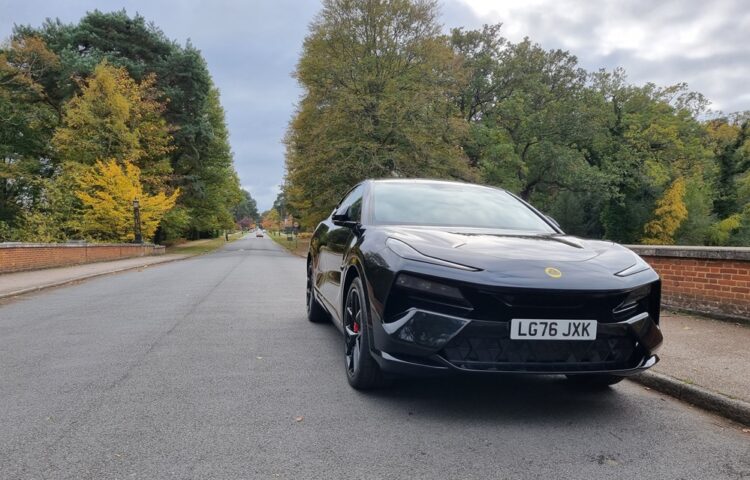
Resistance to change is hardly a phenomenon that needs introducing or explaining. People don’t like change. It’s just a fact of life. Once the change comes along and has been in place for a while, however, the resistance softens and we get used to the new way of things. Maybe we even come to like it, no matter how good we perceived things to be previously. I was thinking of this during my time with the Lotus Eletre. It represented such a radical breakaway from the Norfolk marque’s history when it was first introduced in 2022 that the new chapter was always going to cause much consternation. Going from lithe sports cars to monolithic electric SUVs is like Chopin turning his hand to death metal.
That initial shock has subsided and left us with a car. We reviewed the Lotus Emeya previously, which is the saloon version of the Eletre. Since that review almost a year ago, I’ve seen one other Emeya. This is simultaneously surprising and expected: I really rather liked it but it’s really expensive and if you need something the size of a boat then you’re probably drawn to SUVs like a moth to a flame. Which is where the Eletre comes in. It was introduced before the Emeya and I’ve started to see quite a few of them around.
As our resistance to change in the automotive world has softened, so too has our reaction to prices. £100,000-plus prices are no longer instantly dismissed. So much so that the Lotus Eletre 600 GT SE as tested here doesn’t feel as though it’s burdened with a ludicrous price tag at £108,755. Now, that’s obviously still a lot of money. But what you get in return is an awful lot of car.
So, should we fully embrace the electric era of gargantuan family cars, or should we mourn the passing of small, lightweight sportscars? If you need one of each, Lotus has you covered, with the Emira getting a new lease of life with the 420 Sport.
Lotus Eletre key facts and figures
| Battery | 112 kWh with 109 kWh usable |
| Range | 332 miles as quoted, 250 as tested |
| Power | 603 bhp |
| Torque | 710 Nm |
| Drivetrain | Dual-motor, all-wheel drive |
| 0-62 mph | 4.5 seconds |
| Top speed | 160 mph |
| Length | 5.10 m |
| Width | 2.23 m including mirrors |
| Seats | 5 |
| Boot space | 688 litres |
| Price | From £96,305; as tested, £108,755 |
| Test economy | 2.29 miles per kWh |
| Charge time | 10-80% in 20mins on 350kW public DC charger |
What is the Lotus Eletre?
Apart from being a massive electric SUV, it was the car that relaunched Lotus following its acquisition by Geely, the Chinese company that brings you Volvo and Polestar these days. There are pros and cons to that. It keeps with the times and offers reliability not always synonymous with Lotus previously. But it perhaps lacks a bit of the pizzazz and chutzpah of an Elan, Esprit or Elise.
That’s not to say, however, that it’s a complete dud to drive. Far from it. More on that later. It was something of a victim of its timing more generally, though. There was a regulatory-induced rush to electrification that wasn’t so enthusiastically embraced by the people who actually buy cars. With a softening stance from on high to internal combustion, Lotus has started to move away from pure electrification: the latest Eletre that will be offered to market will be a hybrid. It’s at this point you start to wonder what it might be like with a V8 instead, and the net zero illusion completely fades from view.
So, is the electric Eletre already a relic? Not quite…
What’s the Lotus Eletre like to live with?
Electrification perfectly suits the demeanour of the Eletre. Once you get over the initial shock of the sheer scale of it and open one of the doors, it’s impossible not to be immediately impressed. The Jasper leather interior is nice to the touch, extending to the lower down parts of the cabin where cheap plastic usually resides. Build quality is first rate.
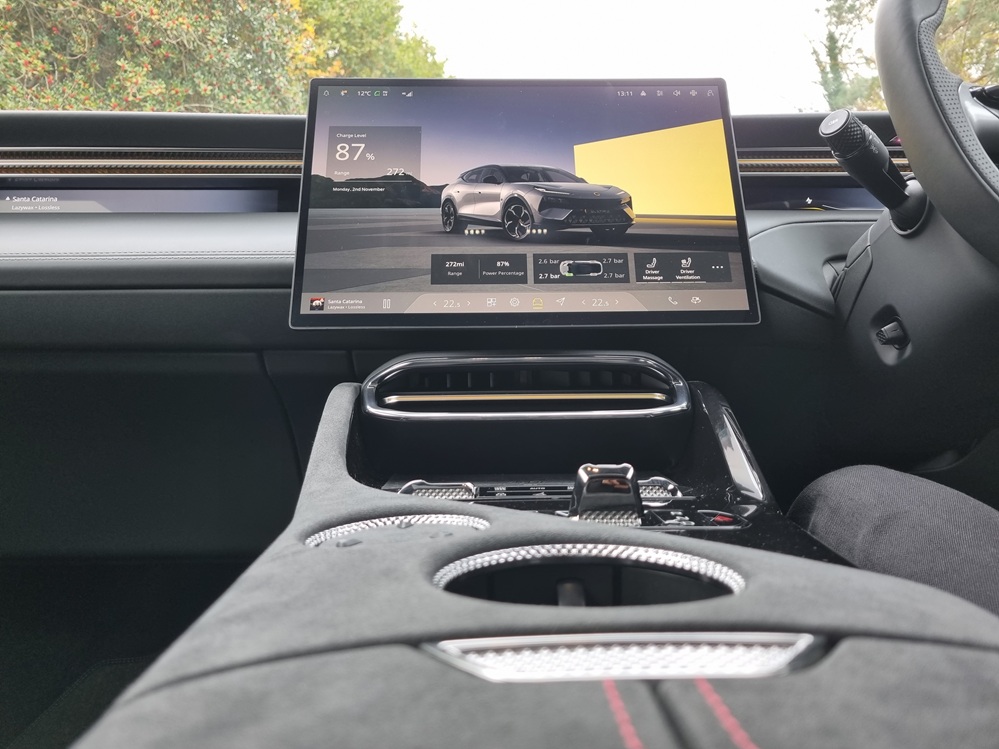
The 15” OLED screen works really well, even if it takes a bit of getting used to. And you will need to get used to it because it controls absolutely everything. There are a couple of physical buttons beneath the screen, but maps, massages, HVAC and media are all in here. It doesn’t always default to your previous screen once you’ve summoned an operation, so you’ll need to familiarise yourself with the shortcuts. This can be a bit frustrating if you’re using Android Auto, as I was, opt to change the fan speed on the HVAC, then get returned to the home screen rather than your map. I also struggled with the brightness at different times of day, which meant more trips into the submenus.
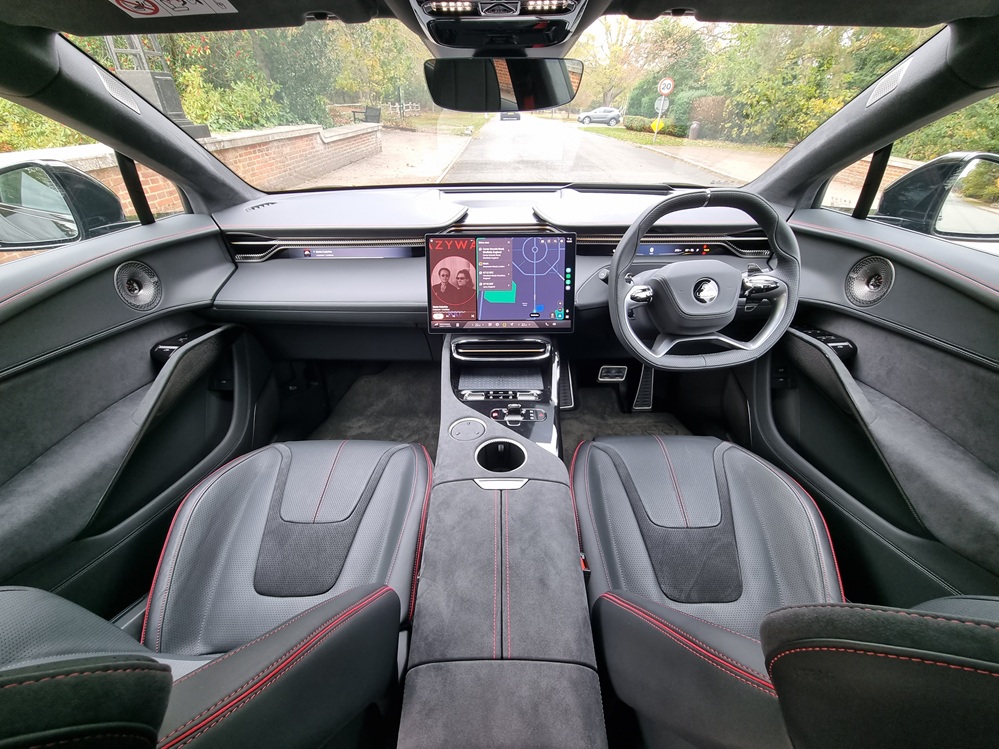
These frustrations subside with familiarity and the system beneath is excellent, including the Lotus app from which you can turn on the heated seats ahead of time. The screen is razor sharp and there’s no lag. There are neat features such as being able to change the colour and spec of the Eletre which is displayed on the main screen. It’s also supremely useful when navigating tight spaces as it can display every angle you need at once.
And you’ll often be navigating tight spaces because it feels like the world has shrunk around the Lotus Eletre. It’s 5.10m long and 2.23m wide. The contents of the sizable 688-litre boot are in a different postcode to the driver. So spacious is the rear that it feels like Lotus has missed a trick by not offering a seven-seat version of the Eletre. Volvo managed it with the EX90. It does mean that rear passengers have a nice time of things, with ample legroom and heated and ventilated reclining seats.
The overhead 360-degree view is essential. On my first day with it I had to drive to Wimbledon and was taken down some residential roads. One featured width restrictors that were clearly put in place long before SUVs became commonplace on the road. Without the camera assistance, I’m quite sure I’d have had to swallow my pride, turn round and find another route.
These proportions, however, really come into their own on the move. The Eletre is a supremely relaxed place to be. You have space and comfort that electrification only heightens. Even when you tap into the performance, it surges forwards in a refined way.
What’s the Lotus Eletre like to drive?
As mentioned, we’re in the Lotus Eletre 600 GT SE here. The 600 means that you get, you’ve guessed it, 600 horsepower, or 603bhp if you prefer. Being an EV, you get a stonking amount of torque, 710Nm of the stuff. That’s sufficient to get this 2565kg (before you’ve put anyone or anything in it) meditation room on wheels from 0-62mph in just 4.5secs. For reasons outlined above, you wouldn’t believe it has arrived at that speed so quickly if you didn’t keep an eye on the speedo.
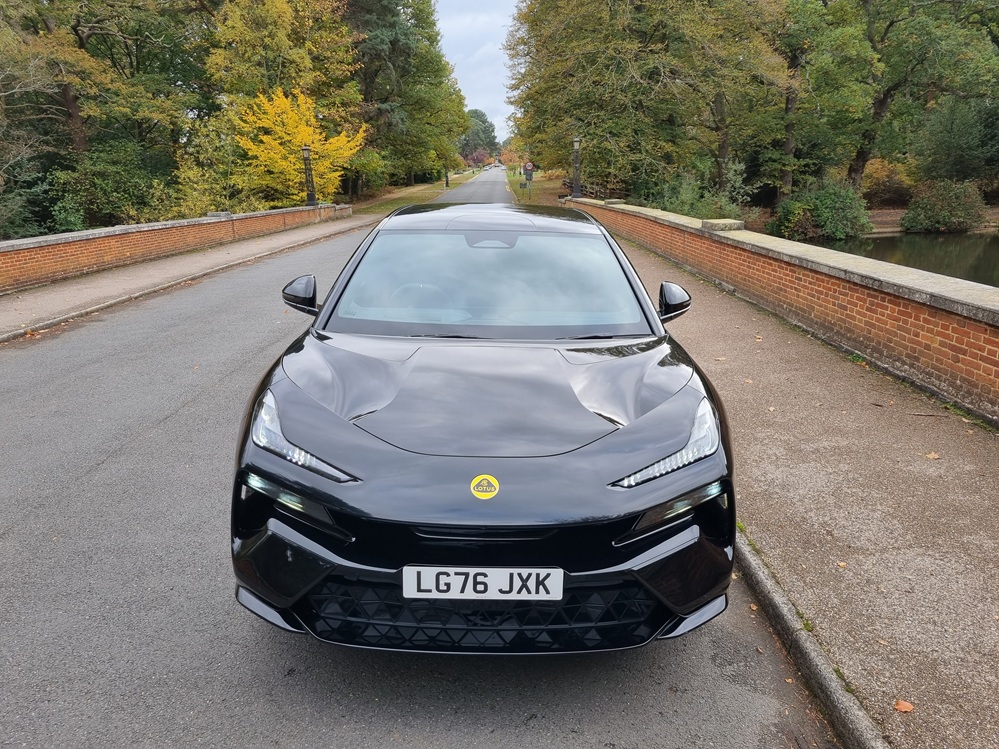
Despite its heft, the Lotus Eletre acquits itself impressively on more enjoyable roads. It will chew up the motorway miles with graceful ease, but there’s a sprinkling of Lotus magic in the chassis. Obviously, it’s not a physics defying miracle machine, but there’s a lovely balance to the car which you don’t necessarily expect.
The active air suspension does a lot to eliminate body roll, leaving you with a consistent setup in terms of its responses. You won’t buy an Eletre to hustle along B-roads, but it’s nice knowing that you can. Lotus has done a lot to ramp up the luxury without completely leaving its roots behind.
In most cars, I don’t usually bother with the individual driver setup. The provided options, Efficiency, Tour and Sport here, often provide the right balance at the right time. I did, however, dive into the configuration with the Eletre. The suspension when left in Tour was too soft, too pillowy. It easily consumes speed bumps, but there is often a secondary bounce to the ride.
This was exacerbated over lumpy sections of tarmac, of which there are many in the UK. Dialling the suspension up to Sport noticeably firms the ride up, which helps to eliminate some of these issues. Paired to the firmer steering provided by Sport, with the more relaxed responses of Tour, I found to be the sweet spot.
On the motorway, leaving everything in Tour works perfectly, then all out Sport for more spirited sessions or to make a brisk getaway from traffic lights. It was on the dreary commutes to work and ferrying the kids around that the Individual mode came into its own.
Lotus Eletre Vs Volvo EX90 – which is the one to have?
Given the sporting edge afforded by the Eletre, the Volvo perhaps isn’t the obvious competition. Given that we’re in the Lotus Eletre 600 GT SE, however, the EX90 feels like a natural alternative. They’re both big and comfortable, with no small slice of performance thrown in. They’re also similarly priced at around the £100,000 mark. You could be tempted from the EX90 by the allure of rarity and enhanced driving dynamics. You could equally be tempted from the Eletre by the allure of the arm around the shoulder afforded by the Volvo.
The Jaguar I-Pace feels like the closest EV in spirit to the Eletre, offering a sporting edge married to a refined and calm interior. Jaguar, however, hasn’t sold a car in years now, so you’d have to dive into the classifieds there. We’ll stick with cars on sale at the time of writing. If you don’t want an SUV, the Lotus Emeya is also sitting right there. You could arguably bring impressive newcomers such as the BMW iX3 to the table, but the Eletre and EX90 feel like a step up from them.
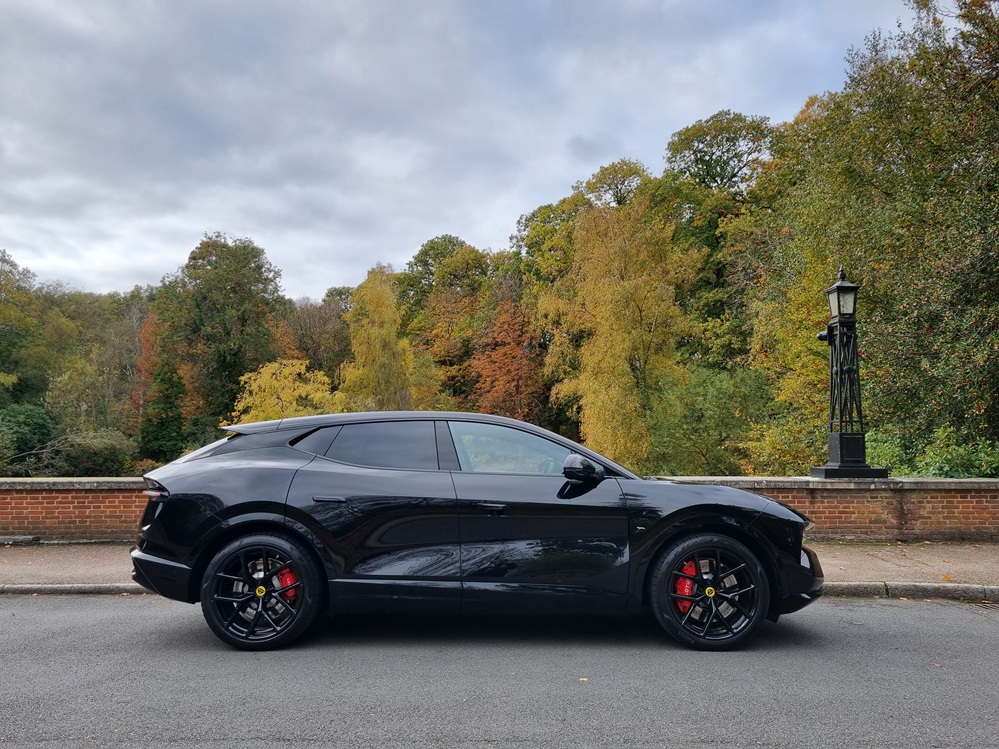
The Eletre is the more striking to look at. The EX90 borrows its design from the Volvo XC90, which has been around for a very long time, so the aesthetics are familiar on UK roads. The EX90 is evolution rather than revolution. So, immediately, the Eletre is one for the contrarians and those who want something different.
The EX90 is the brighter and more spacious feeling of the two. Whilst it offers up serious performance, depending on your spec, it does so almost apologetically. The Lotus Eletre certainly has the edge when it comes to hustling along and embracing the driving experience.
Yet both perfectly suit electrification. They feel made for it. Crawling along on the commute to work, their respective sound systems are excellent (although Volvo’s Bowers & Wilkins unit is superior to Lotus’s KEF system) and you can sit in isolated comfort, keeping the outside hubbub at arm’s length.
It might boil down to a question of how many people live in your house. The EX90 is a seven-seater, with plenty of space for all seven occupants at that. If you don’t need the extra row of seats, then the all-round package offered by the Eletre, with comparable comfort married to rarity and enhanced driving dynamics, make it the pick.
Verdict – the Lotus Eletre
I usually wait a little while before reaching a definitive conclusion on a car. Some, like the BMW M3, reveal themselves from the first few miles behind the wheel, whilst others can take a while to gel with. I’d really liked the Lotus Emeya, so had been looking forward to my time with the Eletre.
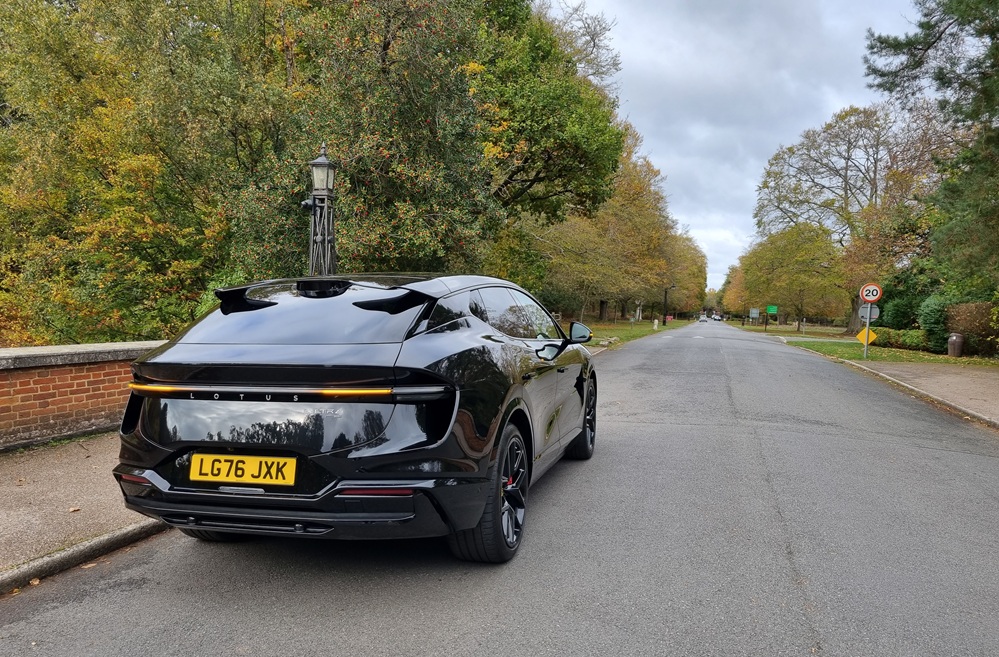
It didn’t disappoint. Now that it’s gone, I kind of miss it. Sure, it’s too big, but it became part of the furniture so quickly. The kids loved it, my wife had no complaints and I was left thoroughly impressed. It’s just a very good car and revealed itself as such straightaway.
It’s no surprise, therefore, that I’ve started to see a few more of them around. The shock has subsided and they’re starting to make sense. I’m sure the move to hybridisation will only further its appeal. It is an exceptional EV and having the safety net (and added performance) of an engine won’t do it any harm. The front trunk is also pretty much redundant. The charging cables came in here but once I’d removed them from their bag I couldn’t get them back in so threw them in the massive boot anyway. Losing that space to an engine just doesn’t matter.
Judged purely as an EV, the Eletre works perfectly. You can tell it was designed with such a powertrain in mind, rather than reworking an existing model in a lineup to crowbar batteries into.
It also makes mincemeat of range anxiety. Its real-world range of around 250 miles (I returned 2.29 miles p/kWh over 300 miles and it has 109kWh usable battery capacity) won’t win any awards, but its charging capability will. Built on an 800-volt architecture, using publicly available fast chargers it can charge at up to 350kW, meaning 10-80% is done in 20mins.
So, here’s a luxury EV with a sporting edge that you can rely on to cover all bases. Just try and avoid width restrictors in Wimbledon.