

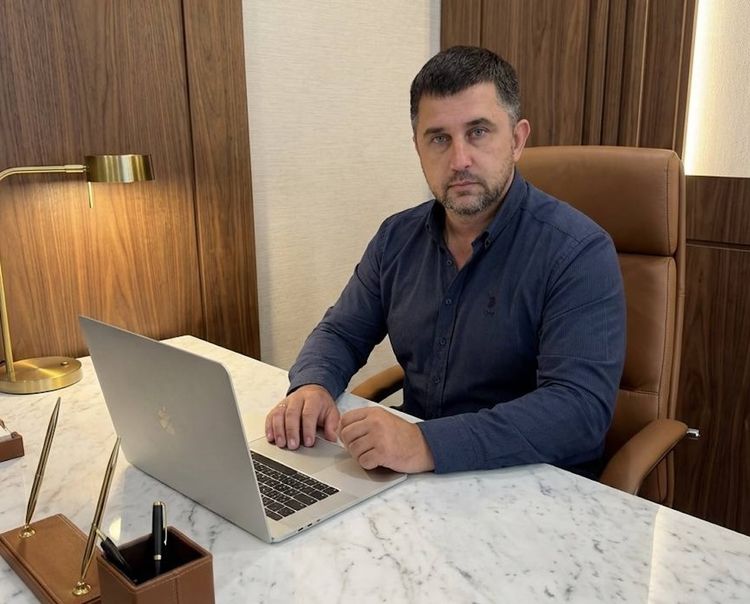
International trade is always a balance between risk, analytics, and intuition. In the jewellery industry, there’s another factor: the high cost of mistakes. Oleksii Kovernikov, an entrepreneur with seven years of experience in the gold segment, built a family business in the Czech Republic, Kove Jewellery s.r.o., which works with B2B clients in Central Europe and directly purchases products from Italy and Turkey. His approach differs from traditional wholesale: instead of reselling ready-made batches, it focuses on detailed demand analysis and creating a product range tailored to specific markets.
Before entering the jewellery sector, Oleksii was involved in the automotive business, then moved to the Czech Republic and started almost from scratch. Today, his company serves over one hundred regular clients, with its central office and warehouse located in Prague. The management is entirely family-run, from logistics and procurement to strategic decisions. We spoke about why gold doesn’t tolerate chaos, how the European market differs from the post-Soviet one, and what mistakes can cost hundreds of thousands of euros.
Oleksii, you entered the jewellery business as an established entrepreneur. What was the most unexpected discovery in this industry?
— The most unexpected thing was realizing that gold is the “most alive” product I’ve ever sold. In the automotive business, everything is more predictable: there’s demand, wear and tear on parts, and clear margins. In the jewellery sector, it’s much more nuanced. Here, the buyer’s mood, the economic situation in the country, and even the cultural preferences of a region are important. I realized that you can’t think in terms of “sell it — earn money.” You need to think strategically: what assortment will be in demand six months from now, how the metal price will change, how the consumer will behave. Jewellery taught me to look ahead at least a few steps.
Many people think wholesale trade is just about reselling. What is really behind your business?
— Wholesale in the jewellery sector is not about a warehouse and a catalog. It’s about constant movement. We spend half of the month on the road: communicating with store owners, looking at display windows, analyzing sales. After that, we fly to Italy or Turkey and place orders based on specific requests. It’s a complex chain where you can’t afford to make mistakes. If you bring in goods “at random,” the money gets frozen. So, our business is more about analytics and risk management than just trading.
Your company operates under a family management model. Why did you choose this model?
— Because in the jewellery business, you can’t delegate everything. We deal with high-value goods, complex logistics, and constant financial control. The family format allows us to keep processes in one hand and make decisions quickly. My wife is involved in strategic planning, my sons help with operational tasks and communications. There’s no distance between management and execution, which makes the company flexible.
Moreover, family business is about trust. In an industry where one mistake can cost hundreds of thousands of euros, trust is a key resource.
You tried working in retail and online, but then moved away from these directions. Why?
— Because we are realists. Online jewellery sales work well in the branded or affordable jewellery segments. But in our case, it’s gold, which needs to be seen, tried on, and compared. People buy such items both emotionally and consciously. Photos cannot convey the feeling of weight and texture.
Our retail store in Prague was an experiment for us. We honestly tested the model, understood its weaknesses, and closed the project. Sometimes, abandoning a direction is not a failure, but a strategic decision.
How difficult was it to launch a company in the Czech Republic as a foreigner?
— To be honest, it was difficult. Banks are extremely cautious, especially when it comes to large transactions and transfers to Turkey or Italy. Opening a bank account took a lot of time and effort. For every large transaction, we had to explain its economic nature. But I see this not as a barrier, but as part of the game rules. Europe works on the principle of complete transparency. If you’re willing to follow these rules, you have the opportunity to build a stable business.
Last summer, you faced a serious incident — a robbery. How do such events change an entrepreneur?
— They make you more cautious and mature. Losing 200,000 euros is not just a number. It’s a lesson. We revised our routes, strengthened security measures, and changed our approach to insurance. The jewellery business is often romanticized: beautiful jewellery, showcases, and sparkle. But behind that, there is serious risk. If you’re not prepared for it, better choose a different field. We’ve learned our lessons and continue working, but with a higher level of control.
The price of gold has almost doubled in the last two years. How does this affect the market?
— Paradoxically, the price increase hasn’t reduced demand. People view gold as a protective asset. When the economy is unstable, the interest in gold only grows.
For business, this means the need for proper inventory management. If you purchase on time, you can gain additional profit just from the price increase. But that requires discipline and precise calculations. We closely monitor the dynamics and try to use it rationally.
How do you think the European jewellery market differs from the Eastern European or post-Soviet one?
— In Europe, more attention is paid to transparency and the documentation side of business. Here, you can’t work on a “gentleman’s agreement.” Everything is recorded, everything is verified.
On the other hand, the European consumer is more conservative. They choose classic designs, calm aesthetics, and quality craftsmanship. This requires the supplier to have a precise understanding of local preferences. There is no universal assortment for all countries.
If we talk more broadly, what drives the jewellery market today — fashion or investment interest?
— Right now, it’s a combination of both. Younger people buy jewellery as a style element, while older generations buy it as a way to preserve capital. Both segments are important. I would say gold has returned to its original function — being a value. It’s once again a symbol of stability. And this is reflected in the stability of sales.
You serve as a judge and expert on international platforms, including judging at the Global1000Award and Glonary Awards, and participating in the Myronyx Global competitions. What does this role mean to you, and on what principles do you evaluate projects?
— Judging on such platforms is not just a status position, but a great responsibility. When you evaluate international-level projects, you not only influence the result of a specific participant but also contribute to setting quality standards in the industry. For me, it’s crucial to look beyond the presentation: to analyze the stability of the business model, the real value of the product, and the long-term development strategy.
In the Myronyx competitions, I particularly pay attention to innovation and systematization. Today, a beautiful idea is not enough — the market demands proven results and transparent processes. For me, it’s important to maintain objectivity and professional ethics. Judging is always a balance between strict criteria and understanding the market context. In the end, I look at projects through the lens of their real impact: do they create sustainable value, set new standards, and can they withstand global competition?
What principle lies at the core of your business philosophy?
— Not to expand faster than the system can handle. Many entrepreneurs want to scale immediately, but in jewellery, that’s dangerous. Here, you need to grow gradually, strengthening the foundation.
We only increase volumes when we are confident in logistics, financing, and demand. It’s less flashy from the outside, but much more stable. For me, it’s not about short-term impressions, but long-term stability.
And finally, what does this business mean to you personally?
— It’s proof that you can start over in a different country and build a functioning system. For me, it’s not just about money, but about respect for the work.
When a client from another country trusts you with the assortment of their store, it’s a responsibility. And I value that trust above all else. The jewellery business is truly not about gold. It’s about reputation.
If you are a successful business person or entrepreneur and would like to feature in our People in Business series, please contact [email protected]