

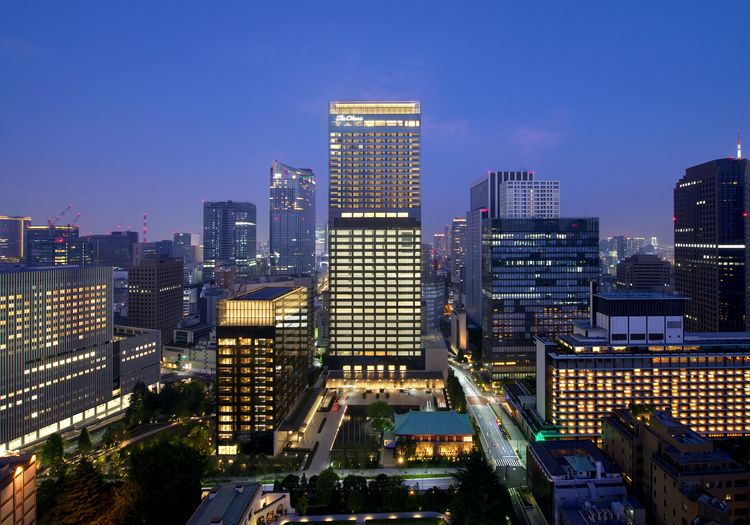
Following its grand opening in 1962, Hotel Okura Tokyo soon became a landmark in the Japanese capital. Its lobby was revered by design enthusiasts and architects the world over. So, when plans were afoot to demolish it in 2014, the acclaimed mid-century ground-floor area, designed by Yoshiro Taniguchi, swelled with visitors keen to catch a final glimpse of its ornate lanterns, iconic world clock and intricate hemp-leaf kumiko lattices.
Thankfully, a conscientious team worked tirelessly to preserve (and recreate) the old-world decadence and architectural charm of the former legendary hotel. As a result, The Okura Tokyo was reborn as a modern, elevated second coming. Guests visiting today will be just as wowed by the warm-hued mezzanine lobby, a homage to the former award-winning design created by Yoshio Taniguchi. The Japanese five-star hotel also promises impeccable nothing’s-too-much-trouble customer service, bundles of considered extra touches, seven superb dining options and a mesmerising 25-metre pool and spa area.
Location
The Okura sits in the quiet business area of Akasaka, rubbing shoulders with international embassies – you can see the US Ambassador’s residence (with outdoor pool) from the hotel and the security presence is notable around the clock. Guests can walk to the popular Roppongi neighbourhood – home to throngs of restaurants and bars and a Don Quijote – in just over 15 minutes, while the closest train station (Kamiyachō) is just over five minutes on foot.
Style and Character
The Okura Tokyo is a renowned Japanese five-star hotel – the original building dates to the early 1960s. It was rebuilt in the late 2010s to bring it up to speed with modern luxury hotel standards while retaining its heritage feel. Design-wise, it is aesthetically sublime – shoulders drop instantly on arrival and eyes dance from feature to feature. The new lobby area, designed by Yoshio Taniguchi, the son of the architect who conceived the original award-winning entrance, is the standout space – a mezzanine with layered textures and warming hues. It is almost an exact replica of the original, with mid-century furniture, lantern chandeliers and the familiar lattices that allow honeyed light to spill onto lacquered tables and carpeted floors. Many original features, including the world clock, are prominently displayed in the lobby. The hotel is split into two wings: Heritage and Prestige.
Service and Facilities
Service at The Okura Tokyo is almost faultless. The team welcome guests with open arms, fighting to take their bags from the moment they step out of the taxi. From here, the check-in process is seamless. Guests are first greeted by an extravagant burst of colour via an elaborate ikebana (flower display), then offered green tea and a Japanese biscuit as a welcome ritual. We arrived far too early after a long journey and were allowed to check into our room within ten minutes – staff here do everything they can to exceed expectations.
The hotel’s facilities make it a difficult place to leave – it’s something of an urban resort packed with restaurants, bars and leisure spaces. In the Prestige wing, guests stretch out in the large, free-flowing gym or swim lengths in the 25-metre pool. Treatment rooms are usually busy with jet-lagged guests being rubbed down by a team of brilliant masseuses, including the upbeat and talented Yoshida, who came to this writer’s rescue with a 90-minute personalised massage that relieved a two-day migraine. Those with cash to spare would be wise to pay extra for club lounge access, where they can drink Japanese whisky and eat canapés while enjoying far-reaching city views – dazzling at night.
Rooms and suites
As mentioned before, the hotel is divided into two wings: Heritage and Prestige. Rooms in the Prestige wing are a touch more modern and better suited to business travellers, diplomats and – some say – presidents. The Heritage building is more catered to holidaymakers and casual visitors keen to make the most of lounging. Colour palettes are similar across both wings: expect neutral tones offset by colourful Japanese origami and abstract artworks. All 508 rooms have smart TVs, large desks, Japanese toilets and deep bathtubs with salts, TVs and views.
From almost every room, vistas stretch across Tokyo’s shimmering skyline, framed by floor-to-ceiling windows. Additionally, 21 rooms also have good-sized balconies – ask for one overlooking the park for an extra treat. Suites and upgraded rooms come with free minibars stocked with Asahi and Suntory beers, fresh juices and snacks, plus free bags and little knick-knacks you can take home as souvenirs – ideal if you haven’t managed to pick something up already. Suites also have the added benefit of a private steam room.
Food and Drink
You’d have to stay about two weeks to try out all of The Okura Tokyo’s restaurants and bars (there are seven in total). We’d suggest making a beeline for Yamazato – the constantly chock-a-block traditional Japanese restaurant serving some of the freshest sushi in town. Sazanka is where you get your teppanyaki fix overlooking Tokyo’s twinkling skyline. Elsewhere, Nouvelle Époque is a fine-dining restaurant that blends French cooking with Japanese flair, while high-end Chinese food is best enjoyed at Toh-Ka-Lin, and Orchid is the place to go for à la carte all-day dining – a lavish array of Japanese and Western breakfast items is served here too. By night, the Orchid Bar provides ambience (and whisky) with its dark, elegant interiors, mood lighting and soothing jazz.
Fact Box
Website: theokuratokyo.jp
Rooms: Heritage Room from JPY 170,000 per night, tax and service charges included, breakfast included (approximately £807).
Prestige Room from JPY 150,000 per night, tax and service charges included, breakfast included (approximately £712).
Address: 2 Chome-10-4 Toranomon, Minato City, Tokyo 105-0001, Japan