

We have never had so much to watch, and perhaps never found it quite so difficult to find something genuinely worth watching. Every week brings another avalanche of prestige dramas, lavish productions, true-crime documentaries and supposedly unmissable films. Streaming platforms compete relentlessly for our attention, promising the next great cultural phenomenon. And yet some of the most extraordinary things on our screens arrive with comparatively little fanfare, waiting patiently to be discovered.
There is a particular pleasure in stumbling across a film you knew almost nothing about, only to find yourself thinking about it days, even weeks, afterwards. Not because it delivered some spectacular twist or left you desperate for a sequel, but because it quietly altered the way you looked at the world.
These are the films that rarely announce themselves as essential viewing. They don’t demand your attention with elaborate plots or famous faces. Often, their brilliance lies in their restraint, in the things they choose not to say, and in their ability to illuminate something about ordinary existence that we have somehow stopped noticing.
Wim Wenders’ Perfect Days is just such a film.
Released in 2023, the Japanese-language drama won its leading actor, Kōji Yakusho, the best actor prize at Cannes and received an Academy Award nomination for best international feature. It was widely admired by critics, but it never became the sort of cultural talking point that dominates dinner-party conversations or streaming charts.
Which is rather fitting, because Perfect Days is a filmabout a man who appears to have absolutely no interest in being noticed.
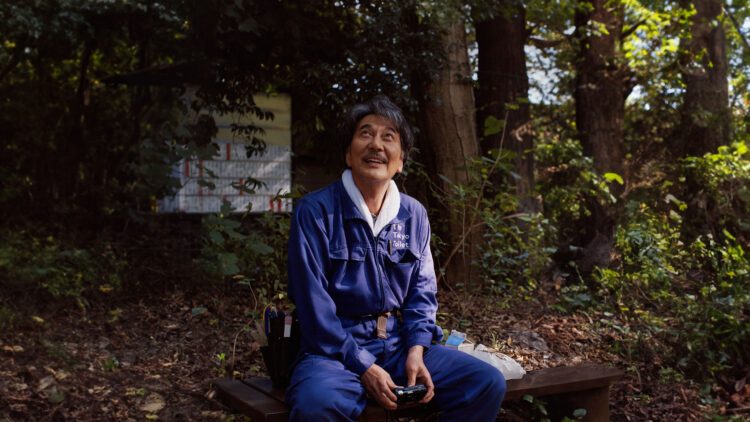
His name is Hirayama. He lives alone in a modest apartment in Tokyo, owns few possessions and spends his days cleaning public toilets. Every morning, he wakes to the sound of someone sweeping the street outside, folds away his bedding, waters his plants and buys a can of coffee from a vending machine before setting off for work.
He drives through Tokyo in a small van, listening to cassette tapes of Lou Reed, Patti Smith, the Kinks and Nina Simone. He cleans toilets with meticulous care, eats his lunch in the same park, takes photographs of trees and spends his evenings reading secondhand books.
Then he gets up the following morning and does it all again.
Inner contentment
On paper, it sounds like an almost wilfully uneventful premise for a feature film. There are no dramatic confrontations, no great ambitions to fulfil, no obvious narrative destination. Yet something remarkable happens as we settle into the rhythms of Hirayama’s existence. What initially appears monotonous becomes strangely compelling. The smallest details begin to matter. And a life that might, from the outside, seem terribly limited gradually reveals itself to be extraordinarily rich.
There is also something deeply intriguing about Hirayama himself.
He is solitary but not obviously lonely, reserved but never unfriendly. He seems to possess an inner contentment that is increasingly rare in a world organised around the pursuit of more: more money, more experiences, more recognition, more things.
He has no smartphone. He doesn’t appear to measure his life against anyone else’s. His pleasures are modest and repetitive, but he approaches them with a quiet intensity that makes them seem almost luxurious.
Is he genuinely happy? Has he discovered some secret to living well? Or is his carefully ordered existence concealing something altogether more complicated?
Wenders is far too accomplished a filmmaker to offer easy answers.
Instead, he invites us to pay attention.
During his lunch breaks, Hirayama sits beneath the trees and watches sunlight filter through the leaves. He takes photographs with a small analogue camera, attempting to capture the fleeting patterns of light and shadow. The Japanese have a word for this phenomenon, komorebi, and it becomes something of a guiding spirit for the film.
There is extraordinary beauty in these moments, not least because they are so utterly ordinary. We have all seen sunlight moving through trees. Most of us barely notice it. Hirayama stops to look.
And slowly, almost imperceptibly, we begin to look too.
Life contract
It is difficult to imagine a film more at odds with the frantic pace of contemporary life. We inhabit a culture in which even relaxation has become another form of achievement. Holidays must be memorable, meals must be exceptional, experiences must be documented and shared. We are forever encouraged to optimise our lives, to pursue the next thing, to believe that happiness is waiting somewhere just beyond our current circumstances.
Hirayama seems to have stepped outside this entire arrangement.
He doesn’t need an audience for his pleasures. He doesn’t seem particularly interested in improving his circumstances. He finds satisfaction in doing his work well, listening to music he loves, reading a good book and noticing the changing seasons.
There is something almost radical about his lack of ambition.
But Perfect Days is not simply an advertisement for minimalism, nor is it one of those sentimental stories in which an apparently humble existence turns out to contain all the answers.
As the film progresses, small disturbances begin to unsettle Hirayama’s routines. Other people enter his carefully constructed world. Hints of a different past emerge. We begin to understand that his tranquillity may have been hard-won, and that the life he has chosen is perhaps as much about what he has left behind as what he has found.
It is here that the film reveals its deeper emotional complexity.
Because Perfect Days is not really asking whether a man who cleans toilets can be happy. It is asking whether happiness can coexist with sadness, regret and loss. Whether contentment means escaping the difficulties of life, or learning to live alongside them.
Yakusho’s performance is nothing short of extraordinary. For much of the film, he barely speaks. Instead, he communicates through the smallest changes in expression: a faint smile, a fleeting look of disappointment, a moment of private amusement.
“There is an entire emotional world behind his face”
There is an entire emotional world behind his face, and Wenders trusts us to discover it without explanation.
By the film’s final moments, that trust is rewarded in a sequence of such exquisite emotional precision that it is difficult to imagine it working in the hands of a less accomplished actor. It is a scene that deserves to be encountered without spoilers, but one that may stay with you long after the credits have rolled.
Tokyo, meanwhile, becomes a character in its own right.
This is not the dazzling, neon-lit metropolis familiar from countless films and travel programmes. Wenders presents a quieter, more intimate city of neighbourhood restaurants, public bathhouses, secondhand bookshops, leafy streets and small, unremarkable pleasures.
Even the public toilets are objects of fascination.
Many belong to the real-life Tokyo Toilet project, which invited leading architects and designers to reimagine public conveniences as beautiful, dignified spaces. It was this project that originally brought Wenders to Tokyo, before the idea evolved into a feature film.
The architectural beauty of these spaces is striking, but so too is Hirayama’s relationship with them. He cleans with extraordinary thoroughness, taking obvious pride in a job that most people would regard as thankless.
In a society that so often equates personal worth with professional status, his quiet dignity is unexpectedly moving.
There is, of course, a potential contradiction in romanticising low-paid manual work. Not everyone has the luxury of choosing a simpler life, and the film leaves important questions about Hirayama’s financial circumstances and earlier existence unanswered.
But perhaps this ambiguity is part of what makes Perfect Days so compelling. Wenders is not suggesting that we should all abandon our careers, dispose of our possessions and become toilet cleaners. He is inviting us to reconsider the assumptions that shape our ideas of success.
And to ask whether the things we spend so much of our lives pursuing are necessarily the things that will make us happy.
Soundtrack
The soundtrack is another of the film’s great pleasures. Lou Reed’s Perfect Day, from which the title is drawn, sits alongside songs by the Kinks, Patti Smith and Nina Simone. Heard through the warmth and occasional crackle of Hirayama’s cassette tapes, these familiar recordings take on an almost magical quality.
They become part of the texture of his life, small moments of private joy that require no justification beyond the pleasure they bring.
And that, ultimately, is what makes Perfect Days so quietly profound.
It asks us to spend two hours with someone whose life, judged by almost any conventional measure, appears unremarkable. Then it gradually reveals how much richness can exist within the boundaries of an ordinary day.
The film requires patience. It asks us to surrender to its gentle rhythms, to accept its silences and resist the urge to demand that something more dramatic happen.
But give it that attention and it offers something increasingly rare: the feeling that the world might be a more beautiful, interesting and generous place than we had remembered.
There are films that make you want to visit somewhere new, meet someone extraordinary or escape your everyday existence.
Perfect Days achieves something rather more unusual.
It makes you want to pay closer attention to the life you already have.