

There is a peculiar cruelty to modern life. We have more freedom than almost any generation before us, more opportunities to reinvent ourselves, more ways to fall in love, more careers to pursue and more possibilities for the people we might become. And yet, for all this apparent abundance, the feeling that we might somehow be getting everything wrong has rarely seemed more pervasive.
Are we with the right person? Doing the right job? Living in the right city? Should we have children? Should we be happier by now? And what happens when the life we thought we wanted turns out to be something quite different from the one we actually need?
These are not particularly original questions. Cinema has been asking them for decades. But every so often a film comes along that articulates the confusion of being human with such startling clarity that it feels as though somebody has been quietly observing your most private thoughts.
The Worst Person in the World is one of those films.
The Norwegian romantic drama, directed by Joachim Trier, has an extraordinary 96% critics’ score on Rotten Tomatoes, an achievement made all the more remarkable by the fact that it is neither a crowd-pleasing blockbuster nor a conventional love story. It is a film about indecision, selfishness, missed opportunities and the uncomfortable realisation that becoming an adult does not necessarily mean figuring anything out.
And it is absolutely wonderful.
Critically acclaimed
Released in 2021, it premiered at Cannes, where its leading actress, Renate Reinsve, won the best actress prize. It subsequently received two Academy Award nominations, including one for best original screenplay. Critics were captivated. Yet for anyone who missed its original release, it remains the sort of discovery that can make an otherwise unremarkable evening feel unexpectedly memorable.
At its centre is Julie, a young woman approaching 30 who is intelligent, attractive, funny and apparently capable of doing almost anything she puts her mind to. The problem is that she has absolutely no idea what she wants to do.
When we first meet her, she is studying medicine. Then she decides she would rather pursue psychology. Then photography. Each new direction arrives with the intoxicating possibility that this, finally, might be the thing that gives her life meaning.
It never quite does.
Her romantic life is similarly unsettled. She begins a relationship with Aksel, an older, successful graphic novelist who seems to offer the stability and certainty she lacks. He is clever, charming and deeply in love with her. They inhabit an attractive Oslo world of books, parties, conversation and cultural sophistication.
“One of the most delightful sequences in recent romantic cinema”
From the outside, it looks like the sort of life many people would be delighted to have.
But Julie is restless. Aksel is beginning to think about children and settling down. Julie cannot quite imagine herself in the future he is proposing. She loves him, or at least believes she does, but is increasingly troubled by the suspicion that she might be living somebody else’s life.
Then, one evening, she wanders into a party to which she hasn’t been invited and meets Eivind.
What follows is one of the most delightful sequences in recent romantic cinema. The two are immediately attracted to each other, but both are already in relationships. They begin testing the boundaries of what constitutes infidelity, flirting outrageously while attempting to convince themselves that they are doing nothing wrong.
It is funny, intimate, absurd and almost unbearably recognisable.
And it sets in motion a series of decisions that will change Julie’s life in ways she cannot begin to anticipate.
Romantic comedy
To describe The Worst Person in the World as a romantic comedy would be both accurate and hopelessly inadequate. It has the wit, charm and emotional exhilaration of the genre, but it is interested in something far more complicated than whether two people will end up together.
It is about the stories we tell ourselves about who we are, and what happens when those stories no longer seem convincing.
Julie is a fascinating protagonist precisely because she is not always particularly likeable. She can be impulsive, self-absorbed, careless with other people’s feelings and maddeningly incapable of appreciating what she has. She wants the freedom to make her own choices but struggles with the consequences when she does.
In other words, she is recognisably human.
Reinsve plays her with an extraordinary combination of intelligence, vulnerability and comic energy. There is something magnetic about the way she moves through the film, sometimes radiantly confident, sometimes painfully uncertain, often both within the same scene.
Her performance won acclaim at Cannes, but it is the quieter moments that linger: the fleeting expression of disappointment when an imagined future fails to materialise, the sudden joy of feeling desired, the dawning recognition that time is passing whether she is ready for it or not.
Trier, who co-wrote the screenplay with Eskil Vogt, structures the film in 12 chapters, along with a prologue and epilogue. It is a playful device that gives the story the feeling of a novel, allowing us to move through several years of Julie’s life while retaining the intimacy of individual moments.
Visually ravishing
The film is also visually ravishing.
Oslo has rarely looked so inviting on screen. Its sunlit streets, elegant apartments, parks and cafés provide the backdrop to a story that feels at once intensely Scandinavian and entirely universal. There is a particular pleasure in watching a film so firmly rooted in a place, yet so unconcerned with presenting that place as a tourist attraction.
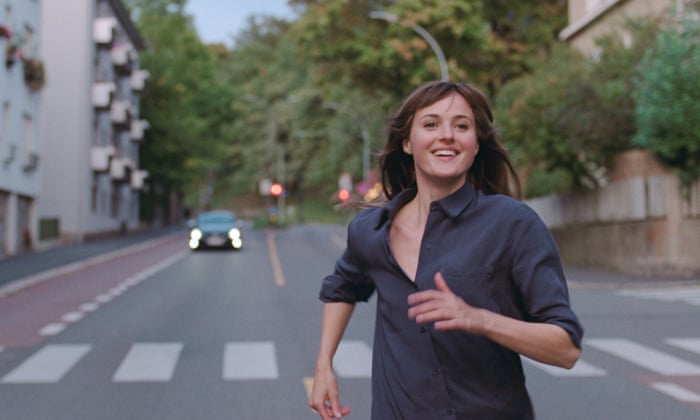
And then there is the sequence that has become the film’s defining image.
Julie runs through the streets of Oslo as the city around her appears to have stopped in time. Cars are motionless. Pedestrians stand frozen in the middle of their daily routines. The world has paused, seemingly to allow her to pursue a moment of romantic possibility.
It is an astonishing piece of filmmaking, simultaneously exhilarating, dreamlike and deeply romantic.
For a few glorious minutes, the film gives physical form to a fantasy almost everyone has experienced: the desire to suspend ordinary life, escape its obligations and follow a feeling wherever it might lead.
But of course, time cannot really be stopped.
And this is where The Worst Person in the World becomes something considerably more profound than its early scenes might suggest.
Beneath its humour and romantic complications lies a growing awareness of mortality. Julie is young enough to believe that her life contains an almost infinite number of possible futures, but old enough to begin discovering that every choice closes off others.
There is a quiet sadness in this realisation, particularly for a generation raised on the idea that it should be possible to have everything.
We are encouraged to think of our lives as projects of continual improvement, in which the right combination of ambition, self-knowledge and determination will eventually produce the person we were always supposed to become.
But what if there is no such person?
What if growing older is less about discovering your true identity than learning to live with the contradictions, compromises and uncertainties that make up an ordinary human life?
Trier explores these questions with remarkable sensitivity. He never punishes Julie for her indecision, nor does he excuse the pain she sometimes causes. Instead, he allows her the complexity that female characters in romantic films have too often been denied.
She is neither a heroine to admire uncritically nor a cautionary example of modern selfishness. She is simply someone trying to make sense of her life while she is in the middle of living it.
Emotional range
The film’s emotional range is astonishing. One moment it is wickedly funny, skewering the pretensions of Oslo’s cultural classes or the absurdities of contemporary relationships. The next it becomes almost unbearably tender.
And without revealing the developments that give its later chapters such emotional force, it is worth saying that The Worst Person in the World changes considerably as it unfolds.
What begins as a sparkling portrait of youthful uncertainty gradually becomes a meditation on love, memory, regret and the terrifying speed with which life passes.
It is a transformation so deftly handled that you may not fully appreciate what Trier has achieved until the film is over.
There is also something wonderfully refreshing about its refusal to provide easy answers.
Hollywood has conditioned us to expect romantic stories to arrive at a moment of clarity: the grand declaration, the decisive choice, the realisation that one person was right all along.
But real life rarely offers such convenient resolutions.
Sometimes we love people and still leave them. Sometimes we make decisions for entirely understandable reasons and regret them later. Sometimes the person we become bears little resemblance to the person we once imagined.
And sometimes there is no villain, no obvious mistake, no single moment at which everything went wrong.
There is just life, unfolding in all its bewildering, contradictory beauty.
This is what makes the film’s title so clever. Julie is not, of course, the worst person in the world. But she frequently feels as though she might be. She disappoints people, questions her decisions and struggles to reconcile her desires with her responsibilities.
Who hasn’t?
It is a feeling that becomes particularly acute as we grow older and begin to recognise the distance between the lives we imagined and the ones we have actually lived.
And perhaps that is why the film has resonated so strongly with critics. Its near-perfect Rotten Tomatoes score is impressive, but numbers alone cannot communicate the peculiar emotional effect of watching it.
It is the sort of film that makes you laugh at something painfully familiar, then catches you off guard with a moment of such tenderness that you find yourself unexpectedly moved.
It is intelligent without being pretentious, romantic without being sentimental, and philosophical without ever losing its sense of humour.
Most importantly, it understands that a life does not have to be perfect to be meaningful.
There are films that offer us an escape from reality, transporting us into worlds more glamorous, exciting or extraordinary than our own.
The Worst Person in the World does almost the opposite.
It takes the confusion, disappointments, fleeting joys and imperfect decisions of everyday existence and makes them feel worthy of the most beautiful cinema.
And by the time it ends, you may find yourself looking back at your own life, at the people you have loved, the choices you have made and the roads you never took, with a little more tenderness than before.
For all its romantic complications and existential uncertainty, that may be its greatest achievement.
It reminds us that none of us really knows what we’re doing.
And that perhaps we don’t have to.