

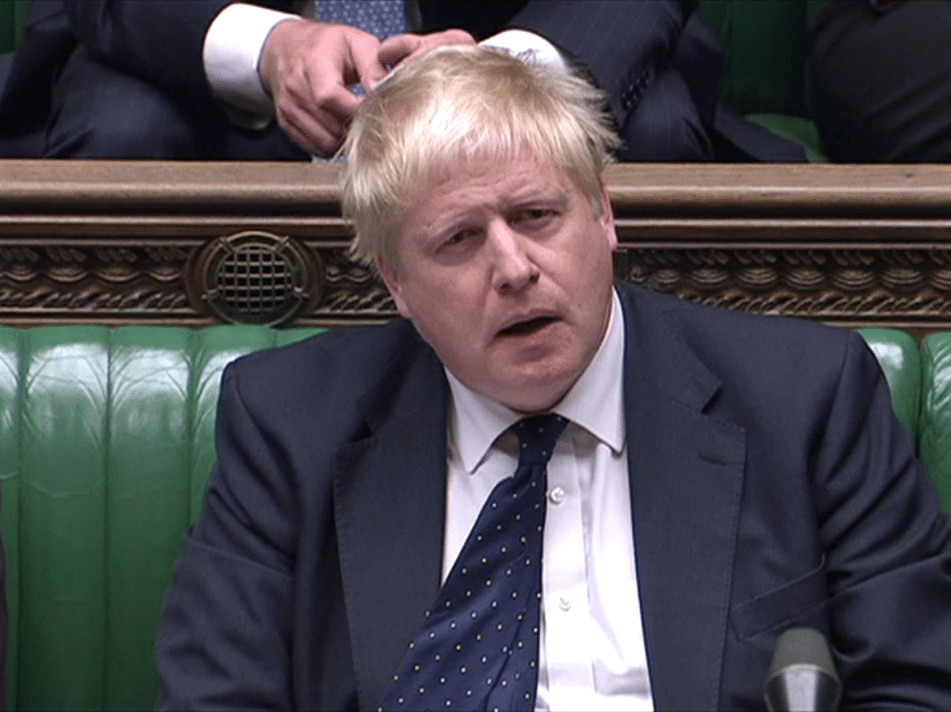
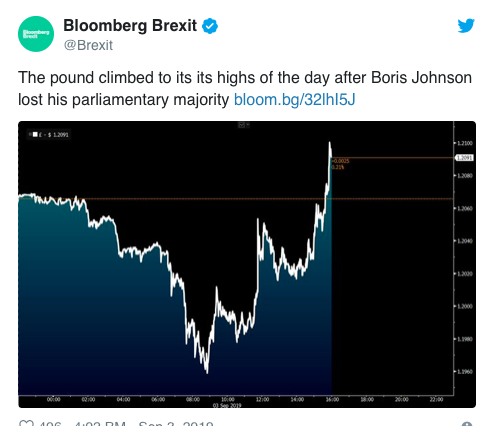
In what is undoubtedly a first, the currency was buoyed by the sitting government losing its majority as Tory Phillip Lee defected to the Liberal Democrats today, losing Boris Johnson his working majority of one with the DUP.
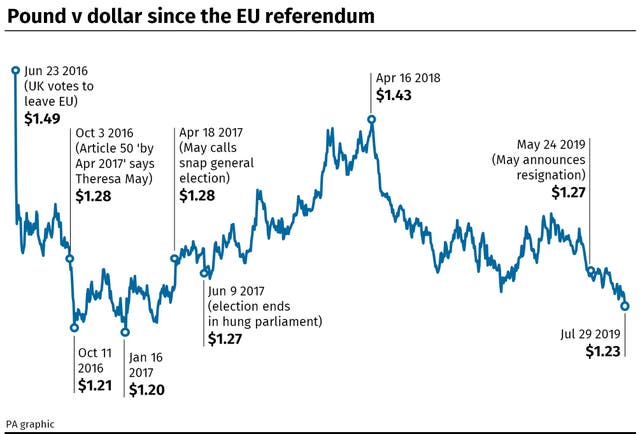
The pound, which had been plummeting at the twists and turns of Boris Johnson’s no-deal Brexit threat, had slumped to its lowest level against the US dollar since 1985, surpassing a previous 2017 low to be worth less than 1.20 dollars.
But following the news that Johnson had lost his majority, it recovered again in what will be a major embarrassment for the Conservative Prime Minister, and leapt back to $1.207, where it ended last night
The pound has been more volatile since the 2016 EU referendum result, including a so-called “flash crash” in October which most analysts do not count when discussing historic lows of the currency.
Plunging pound
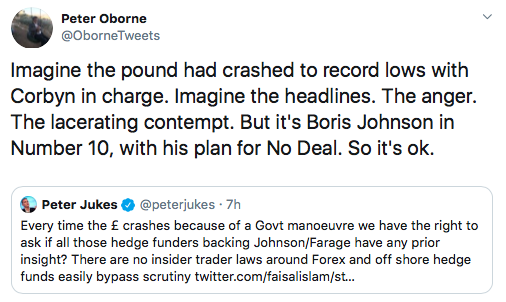
As the extended Brexit deadline approaches, sterling has been battered by news of Boris Johnson’s plans to prorogue Parliament and was given another knock on Monday night by rising rumours of a general election.
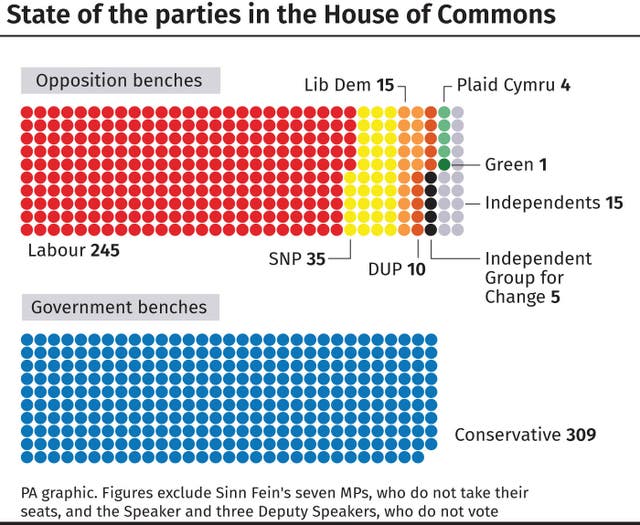
The defection means Boris Johnson’s working majority in the Commons has been wiped out just hours before a crunch vote on Brexit.
The Prime Minister is desperately trying to fight off a Tory revolt over measures aimed at blocking him from taking the UK out of the European Union without a Brexit deal on October 31.
But his task became even more difficult after former minister Phillip Lee dramatically defected to the Liberal Democrats, crossing the floor of the Commons as Mr Johnson delivered a statement to MPs.
Boris Johnson confirms he would respect a vote to stop no deal
In another signal that Boris Johnson’s gambles and threats are beginning to leave him little room to manoeuvre, when Labour MP Angela Eagle asked the PM if he would respect a parliamentary vote to stop him crashing the country out of the EU with no deal, he told parliament that he would respect the law.
“If a bill passes which makes it illegal to leave without a deal, will he and his government abide by the rule of law?” she asked, and Johnson responded that the government “will of course uphold the constitution and obey the law.”
Moments later, Joanna Cherry of the Scottish National Party asked for Johnson’s word that he would respect legislation passed by the House of Commons and court decisions in England and Scotland. He replied by referring her to the answer he gave Angela Eagle.
Many suspect that if parliament takes control it is a way that Boris Johnson can blame MPs for the impossible situation he has created, promising to leave the EU on October 31 with no signs of any alternative that he has come up with to the backstop he objects to.
Bullying
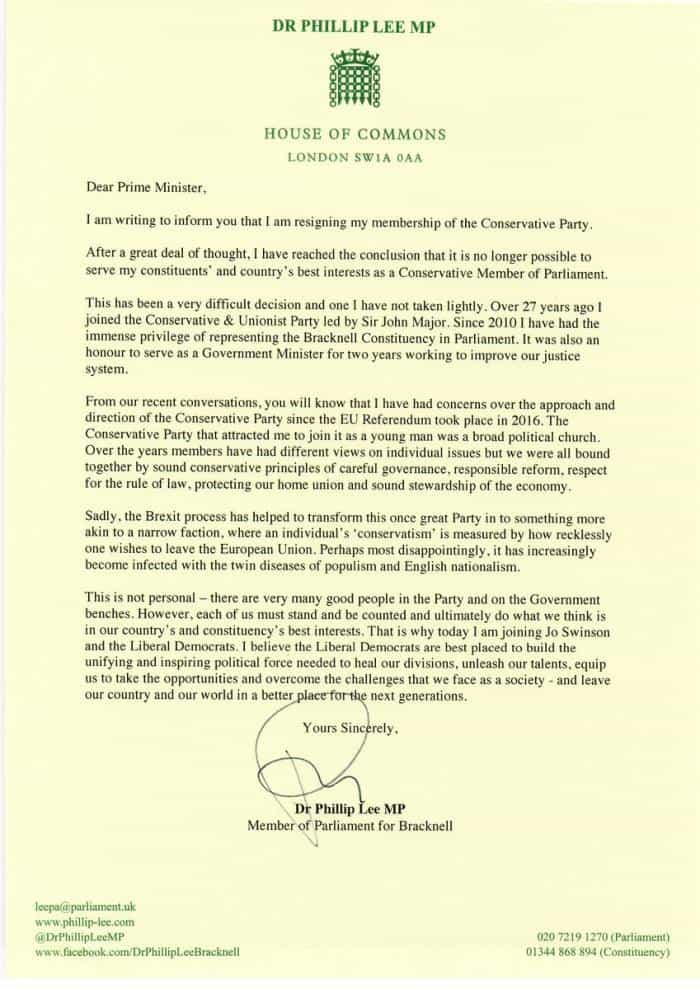
Phillip Lee, whose defection has cost Johnson his working majority, cited bullying from Johnson’s advisors as one of his reasons for quitting. But he said the “straw that broke the camel’s back” was Cabinet minister Jacob Rees-Mogg’s dismissive treatment of a doctor concerned about patient mortality after a no-deal Brexit during a radio phone-in on Monday.
Brexiteer extremist Rees-Mogg had mocked the senior consultant’s concerns about how many people will die as being a “fear-mongering” “Remoaner” despite Dr David Nicholl having been involved in drawing up the government’s plans to mitigate the damage of no-deal to the NHS.
“I don’t expect to be the last person to make this decision,” Lee, a doctor himself, told Sky News. “I haven’t left my party. My party has left me.”
The former Justice Secretary said the Brexit process had “helped to transform this once great party in to something more akin to a narrow faction, where an individual’s ‘conservatism’ is measured by how recklessly one wishes to leave the European Union”. “Perhaps most disappointingly, it has increasingly become infected with the twin diseases of populism and English nationalism.”
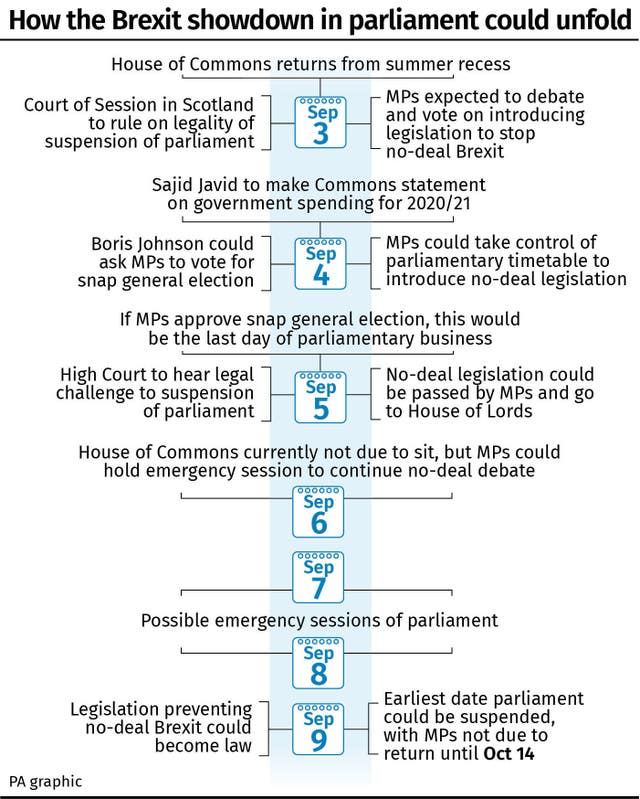
The Prime Minister has signalled he will try to call a snap general election if he is defeated by the cross-party alliance’s bid to take control of the Commons agenda and pass legislation which would prevent a no-deal Brexit on October 31.
The move would require the Prime Minister to seek a delay to Brexit until January 31, 2020 if no agreement has been reached and MPs have not approved a no-deal withdrawal.
Mr Johnson told MPs the legislation aimed at blocking a no-deal Brexit would “force me to go to Brussels and beg an extension” and “destroy any chance” of negotiating an agreement.
Boris Johnson’s Government has “no mandate, no morals and, as of today, no majority”.
Labour leader Jeremy Corbyn said Mr Johnson was leading a Government with “no mandate, no morals and, as of today, no majority”.
In a sign of the bitter divisions within the Conservative ranks, former chancellor Philip Hammond accused Downing Street of “rank hypocrisy” and warned of the “fight of a lifetime” if officials attempt to prevent him from standing at the next general election as a Conservative candidate.
Dominic Grieve, who served as attorney general in David Cameron’s government, said threats to withdraw the whip from any Tories voting against the Government demonstrated Mr Johnson’s “ruthlessness” in power.
Ex-Cabinet minister Justine Greening said she would not stand as a Tory candidate at the next election, telling the PA news agency that a no-deal Brexit was “the most profoundly un-Conservative policy you could possibly have”.
Ms Greening, Mr Hammond and Mr Grieve all confirmed they would join opposition MPs in voting for legislation designed to delay Britain’s exit from the EU if no agreement can be struck with the European Union before October 31.
Former Foreign Office minister Alistair Burt, one of the rebel Tory sponsors of the cross-party legislation, also said he would not fight the next election due to a “fundamental, and unresolvable disagreement with our party leadership” over Brexit.
Dr Lee’s defection wiped out the Tory-DUP majority in the Commons.
He said: “This Conservative Government is aggressively pursuing a damaging Brexit in unprincipled ways.”
Mr Johnson sought to scare off a rebellion by indicating he would push for a snap general election if MPs succeed in their bid to seize control of parliamentary proceedings and confirming plans to strip rebels of the whip, preventing them from standing for the party.
Mr Hammond, who was reselected as Tory candidate for Runnymede & Weybridge on Monday night, told BBC Radio 4’s Today programme: “A lot of my colleagues have come under immense pressure. Some have responded to that by saying ‘enough, I’m going’. That is not going to be my approach. This is my party. I have been a member of this party for 45 years.”
The Prime Minister held a last-ditch meeting with potential rebels including former cabinet ministers Mr Hammond, David Gauke and Greg Clark on Tuesday morning.
A source close to the group said Mr Johnson “gave an unconvincing explanation” of how a deal could get through in the time allowed and he could not provide a “reasonable answer” on why the Government had not yet provided the EU with alternatives to the Irish backstop.
Meanwhile, Mr Corbyn gathered Westminster opposition leaders for talks in his parliamentary office to discuss tactics.
One of the key issues is whether Labour would back Mr Johnson’s call for an early election, pencilled in for October 14.
“We want a general election, as do all the other parties,” Mr Corbyn said, but he added that “the priority is to prevent a no-deal exit from the EU” on October 31.
Will Boris Johnson be allowed to call an election?
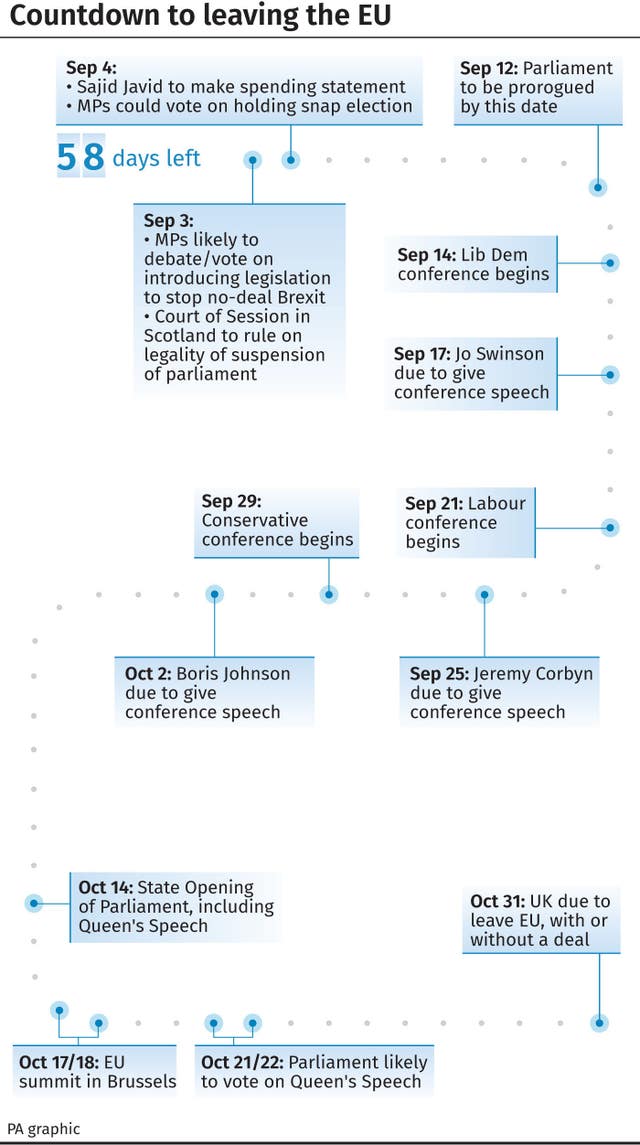
Under the Fixed-term Parliaments Act a two-thirds majority is required for an early election and critics have claimed Mr Johnson could seek to simply delay the date of the poll until after Brexit.
But Downing Street insisted that was wrong and there was no discretion over timing once Parliament has been dissolved.
The Prime Minister’s official spokesman confirmed that if there was to be an election it would be held before the European Council summit of EU leaders on October 17.
He said: “The Prime Minister does not want to hold an election. If, by destroying his negotiating position, MPs force an election, then that would take place before the October European Council.”
The spokesman warned that the rebel legislation was a “blueprint for legislative purgatory” which would cost around £1 billion a month for an extension to the Brexit process that was “very clearly in Brussels’ interests, not in the British interest”.
Mr Johnson could take the unenviable title of shortest-serving British prime minister should he lose a snap election next month, falling short of George Canning’s 119-day stint in 1827.