

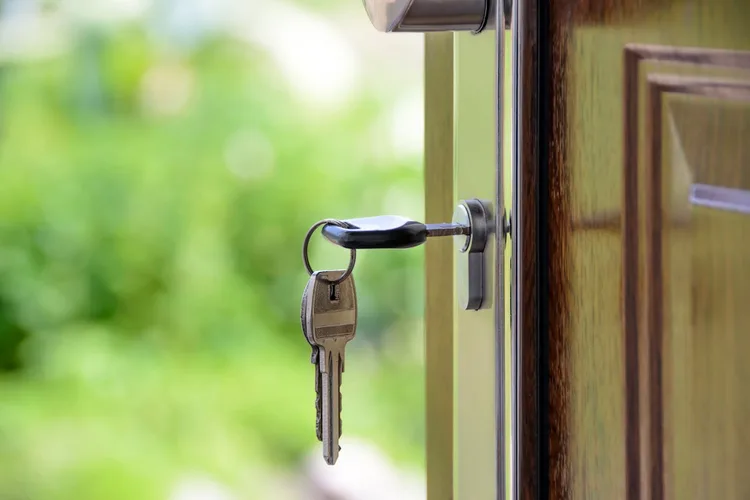
There’s a particular sound that anyone who has lived in different parts of the UK comes to recognise. It’s the sound of a front door being locked. Not just closed — locked, with that distinct double-turn of a deadlock or the satisfying clunk of a multi-point system engaging.
In some parts of the country, you hear it from every house on the street, several times a day. In others, you’d be mildly surprised to hear it at all. Doors get pulled to. Latches click. But the deliberate, audible act of locking up — the practised choreography of bag down, keys out, lock turned, keys away — is a regional behaviour as much as a personal one.
This is one of those small social patterns that nobody talks about explicitly but everybody knows. It’s also a window into something larger.
Two Britains, locked differently
If you stand outside a typical home in central London and another in a market town in Devon, the same front door might be doing very different work.
In urban centres — particularly in inner London, Manchester, Birmingham, Leeds, and the dense parts of cities like Liverpool, Bristol, and Newcastle — front doors have become serious infrastructure. Multi-point locking systems on uPVC and composite doors. Anti-snap euro cylinders to BS 3621 or TS007 3-star. Smart deadbolts. Video doorbells. Keyless entry. Many homeowners have at some point sat through a 20-minute conversation with a locksmith about which standard their insurance requires and which specific cylinder model meets it.
In smaller towns and rural areas, particularly across parts of Wales, the South West, the East Midlands, and rural Scotland, the pattern is often quite different. Doors that worked in 1995 are still working in 2025. The original Yale lock fitted when the house was built remains fitted. Some homes don’t lock the back door during the day. A surprising number don’t lock the front door if someone’s home, even at night.
The temptation is to read this as a simple urban-rural divide, with the implication that rural Britain is naive about security and urban Britain has had to grow up. That reading misses what’s actually going on.
What the burglary statistics actually show
The Office for National Statistics publishes regional crime data quarterly, and the patterns are more interesting than the urban-vs-rural narrative suggests.
London, despite its reputation, has burglary rates that are below several other English regions when adjusted for population. The North East and Yorkshire and the Humber have historically had higher residential burglary rates than parts of the South East. Within any single region, the variation between specific neighbourhoods can be larger than the variation between regions. A particular postcode in outer London might have ten times the burglary rate of a postcode three miles away.
What’s more, the relationship between actual burglary risk and how seriously residents take security isn’t tightly correlated with the data. People in areas with high burglary rates often haven’t materially upgraded their security in years. People in low-rate areas sometimes invest heavily in modern locks, alarms, and smart systems despite facing relatively low statistical risk.
What’s actually driving the divergence isn’t crime data. It’s something more cultural.
The insurance trail
The most telling regional pattern in UK home security is the one created by insurance company practices over the last fifteen years.
Insurers have, increasingly, made specific security requirements a condition of cover. Five-lever mortice locks to BS 3621. Approved multi-point locking. Patio door restrictors. In some postcodes — particularly in London, the South East, and parts of the major regional cities — these requirements have become non-negotiable, with policies declined or premiums significantly loaded if the home doesn’t meet them.
In other parts of the country, the requirements are softer. Insurers in low-claim postcodes are more willing to cover homes with older locking standards because the actuarial risk is lower. The result, over time, has been a regional divergence not in actual security needs, but in what residents have been required to install.
This creates an interesting feedback loop. Homeowners in higher-risk postcodes upgrade their hardware because insurers require it. The upgrades work. Burglary becomes harder. Insurance claims drop. Premiums stabilise. Meanwhile, homeowners in lower-risk postcodes continue with older hardware that would arguably benefit from upgrading on its own merits but isn’t being driven there by insurance pressure.
By 2025, the cumulative effect of this divergence is significant. Two homes built to identical specifications in 1995 — one in Croydon, one in rural Shropshire — likely have very different front door hardware now. The Croydon home has probably had its locks replaced two or three times. The Shropshire home is likely still running its 1995 fittings.
The class question
There’s a second pattern, layered on top of the regional one, that’s harder to talk about but increasingly visible: home security has become a marker of class as well as geography.
Walk through a wealthy area of any UK city and you’ll see the technology stack of contemporary security: smart doorbells with HD cameras, pull-up bollards on driveways, monitored alarm systems, fingerprint deadbolts, internal hallway cameras feeding to phones. The cumulative cost of these installations runs into thousands of pounds per home.
Walk through a less affluent area in the same city and you’ll see something quite different. Older locks, often the originals fitted when the property was built or last refurbished. Window catches that haven’t been replaced. Doors that still rely on a single Yale latch. Sometimes a cheap wireless alarm with a sticker. The investment per home is dramatically lower, despite the burglary risk often being statistically higher.
This isn’t because lower-income households don’t care about security. They obviously do. The pattern is created by the simple fact that contemporary home security technology is expensive, and the cost of upgrading hardware is non-trivial when household budgets are tight. A multi-point composite door costs £1,500-£3,000 fitted. A smart alarm system runs £400-£1,000 plus monthly monitoring. Even a single high-security cylinder upgrade is £80-£150 per door.
The result is that the parts of Britain most exposed to burglary risk are often the parts least able to afford the security upgrades that would address it. The parts least exposed to risk are often the parts most heavily invested in defending against it. This isn’t anyone’s fault, exactly, but it is a pattern worth noticing.
What specialist retailers see
Over years of running Home Secure, a UK specialist home security retailer, you start to recognise the regional and demographic patterns in customer orders. Smart deadbolts and high-end cylinders ship disproportionately to London postcodes. Replacement uPVC door handles in standard configurations ship disproportionately to working-class areas of Northern England, the Midlands, and South Wales — homes built in the uPVC boom of the 1990s and 2000s, now needing their first replacement parts. Period property hardware ships to conservation areas in Edinburgh, Bath, Brighton, and the wealthier London postcodes.
The orders tell a story about where the country has invested its security spending and where it hasn’t. They also tell a story about timing. Hardware fitted in the 1990s is reaching the end of its functional life now, regardless of postcode. The next ten years will see a wave of replacement-parts demand from areas that haven’t upgraded since installation — much of it in regions that have historically been under-invested in security infrastructure.
A modest conclusion
The geography of UK home security is a quieter version of the geography of UK inequality more broadly. It tracks income. It tracks insurance. It tracks the difference between areas where institutions have driven a particular standard of investment and areas where they haven’t. The doors of Britain are locked, or unlocked, in ways that say more about the country’s structural patterns than about the choices of individual homeowners.
The hopeful version of this story is that the pattern isn’t immutable. Hardware costs are falling. Smart security technology is becoming dramatically more affordable. Insurance requirements that once applied only to high-risk postcodes are spreading. The next decade may well see the regional gap close — not because rural and lower-income Britain has been forced to upgrade, but because the cost of doing so has finally come down to the point where it’s reasonable.
In the meantime, the sound of doors being locked, or not locked, will continue to vary by postcode. It’s a small thing. But it’s worth noticing what small things can mean.