

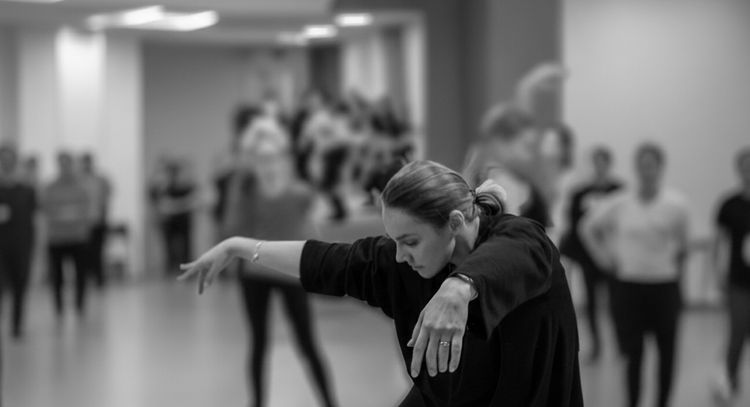
In an industry where creativity has traditionally been seen as a sphere of inspiration, her approach shows that choreography is directly connected with business thinking: planning, team management, scaling, and brand building. Behind every successful dance company stand processes, budgets, strategies for participating in championships, work with audiences, and reputation management.
That is why this conversation goes beyond art. It is about management, leadership, and building sustainable projects in the creative industry.
The topic of our conversation is the evolution of choreography in an era when the stage becomes a media platform and a performance becomes a competitive product of the global market.
Marina Gladchenko is a choreographer, teacher, artistic director, and choreography industry manager (product manager) whose career has long gone beyond the borders of a single country. A seven-time world champion in dance show, founder of the “Skazka Dance Space” school in Russia (2014–2023), author of more than 200 choreographic works, and mentor of dance companies across Europe, she now works in Lisbon and consults schools internationally. In 2026, Marina is not just a choreographer, but a strategist of the stage, shaping new standards in the industry.
In 2026 the dance industry has become much larger and more media-driven. What has changed for choreographers at the professional level?
Everything has changed. Today a choreographer is not only the author of movements but also a product manager, strategist, and team curator. When I create a piece, I think about it as a product: who it is for, what emotional result it should create, how it will look both in a live theater and on video, and how it will live on social media.
In 2026 dance exists in several dimensions at once: the stage, the screen, digital archives, and international festivals. That’s why it’s important to understand the market, trends, and the audience’s expectations. In the past, it was enough to be talented. Today, you must be systematic.
You often mention that your first degree was in economics and your second in choreography. How did that influence your way of thinking?
It shaped my entire professional approach. My economics education taught me to see structure, strategy, long-term planning, and risk assessment. My choreography education gave me the tool of expression — the language of the stage and the methodology behind it.
Together, they formed my product-thinking mindset. I don’t create “a piece for the sake of a piece.” I create a concept that must work. When you understand both art and systems, you begin to manage the process instead of depending on circumstances.
In 2026 this is especially relevant. The world demands professionals with hybrid expertise.
You are the author of more than 200 choreographic works. Which one became a turning point for you?
One of the key works was a large production based on the story of Oskar Schindler, which we presented at the World Championship in Germany. There were 19 performers on stage — it was a large-scale dramatic form rather than a камерная story.
We worked on it like a theater production, with a deep script, emotional transitions, and internal group dynamics. That piece proved that dance show can be a serious artistic statement, not only a visual spectacle.
That was when I realized that meaning and idea are stronger than any acrobatics. This principle has stayed with me ever since.
Your school “Skazka Dance Space” worked in Russia for almost ten years. What experience did you gain from managing a collective of 300 students?
It was a real school of management. Three hundred students is no longer a small studio — it’s a full system with teachers, schedules, methodology, communication with parents, and participation in championships.
I personally supervised choreography, teaching methods, teacher development, and travel organization. It taught me how to scale ideas and work long-term.
When the school became champion of Russia and a seven-time world champion, it was not only the children’s talent — it was the result of a well-built structure. That’s where I fully developed as a choreography manager.
You actively work as a judge in international projects, including the Myronyx Global platform. What does this role mean to you?
Judging is a huge responsibility. Working with projects connected to Myronyx Global, I see how much the level of dance companies around the world has grown.
Today we evaluate not only technique but the integrity of the product: dramaturgy, concept, use of space, originality. I always look for honesty and inner logic in a piece.
A judge should not be a punisher but an analyst and mentor, giving companies an understanding of where to move next. For me it’s a way to influence the development of the industry globally.
How do you see the future of children’s choreography? You work with children from the age of five.
I believe children’s choreography must be healthy and respectful. I started rhythmic gymnastics at seven and understand how important it is to preserve a child’s love for movement instead of breaking it with adult ambitions.
My method for children aged 5–12 is built on developing imagination and emotional intelligence. We teach children not only how to move but also how to understand what they are dancing about.
In 2026 it is especially important to raise a personality, not just a performer. Dance should help a child grow as a human being.
You now live and work in Lisbon. What does the international environment give you?
It expands your horizon. In Europe there are more interdisciplinary projects and collaborations with theaters, producers, and media platforms.
I teach in studios, choreograph for companies, and consult schools — including online. It gives the feeling that you’re working not inside one system but on the international stage.
In 2026 borders are practically gone. What matters is the ability to adapt to different cultures and styles.
What would you like to change in the industry in the coming years?
I want choreographers to be seen as strategists, not as service staff for the stage. Dance is a powerful tool for influence, for shaping meaning, and for addressing social issues.
We need more projects with depth and more well-designed concepts. I dream of creating an educational platform where teachers can study dramaturgy of choreography, product thinking, and management in dance.
Because the future belongs to those who combine creativity with system thinking.
And honestly, in 2026 it’s no longer enough to simply be talented — you have to be a leader.