

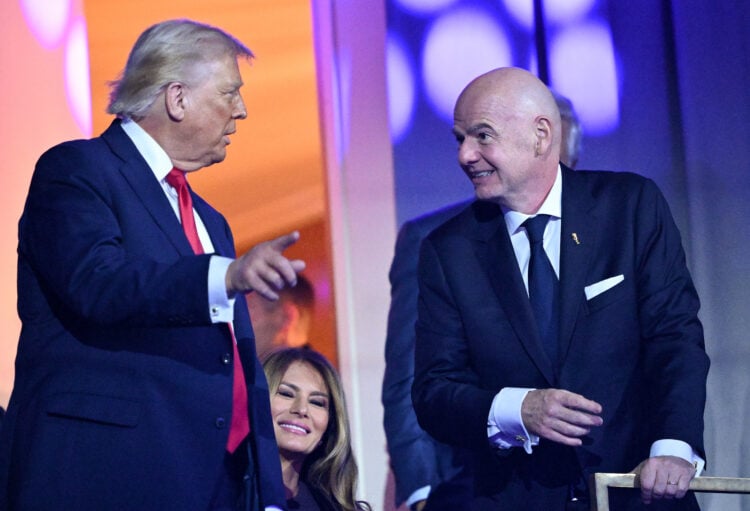
Gianni Infantino has spent the better part of a decade convincing the world that FIFA had changed.
When he replaced Sepp Blatter in 2016, he promised a new era of transparency after years of corruption scandals that brought football’s governing body to its knees. Whether anyone truly believed him was another matter, but at least the pretence was maintained.
Not anymore.
The extraordinary decision to suspend Folarin Balogun’s automatic World Cup ban after Donald Trump personally intervened has detonated one of the biggest governance scandals FIFA has faced since the Blatter years.
This is no longer simply about whether Balogun deserved a red card. Football has survived dubious refereeing decisions for over a century.
This is about something infinitely more corrosive: the perception that FIFA’s rules apply differently depending on who picks up the phone.
Trump has now openly admitted that he contacted Infantino to ask for a review of the decision. FIFA insists its judicial bodies are independent, but the sequence of events is impossible to ignore. A punishment that everyone understood to be automatic suddenly wasn’t. A disciplinary code that had appeared unequivocal suddenly became remarkably flexible.
The backlash has been ferocious.
UEFA has accused FIFA of crossing a “red line”. Belgium has challenged Balogun’s eligibility. Coaches, players and pundits have questioned whether the integrity of the tournament has been irreparably damaged. What should have been a celebration of football has become a debate about political influence and institutional credibility.
And then came the intervention that should truly terrify Infantino.
Sepp Blatter weighed in.
Pause for a moment to appreciate the irony.
Blatter is hardly football’s moral compass. His own presidency became synonymous with corruption, patronage and backroom dealing. His downfall was supposed to clear the way for Infantino’s “new FIFA”.
Yet when even Blatter is publicly accusing his successor of betraying the game’s integrity, you know the situation has become untenable. It takes quite something to make Sepp Blatter look like the guardian of football ethics.
Infantino has always projected himself as the consummate political operator. He has cultivated relationships with world leaders from Doha to Washington, presenting himself as the indispensable diplomat capable of expanding football’s global reach.
But therein lies the problem.
The FIFA president appears increasingly comfortable operating in political circles while forgetting that football’s legitimacy rests on one simple principle: the rules must apply equally to everyone.
The Balogun affair has shattered that illusion.
Supporters can accept refereeing mistakes. They can even accept controversial VAR decisions. What they cannot accept is the suspicion that the disciplinary process itself can be rewritten after a call from the White House.
That perception is fatal.
The parallels with FIFA’s darkest years are impossible to ignore. The organisation once insisted there was nothing wrong while scandal after scandal engulfed it. Each new controversy was dismissed as isolated. Each defence only deepened the sense that those at the top simply did not understand how much trust had already been lost.
History has a habit of repeating itself.
Infantino’s infamous declaration in Qatar – “Today I feel Qatari” – became an instant symbol of tone-deaf leadership. Today, another phrase feels more appropriate.
Today, Gianni, you should feel finished.
Because if FIFA is serious about protecting the integrity of the world’s game, it cannot survive the perception that political influence trumps sporting justice.
And neither should the president who allowed that perception to take hold.