

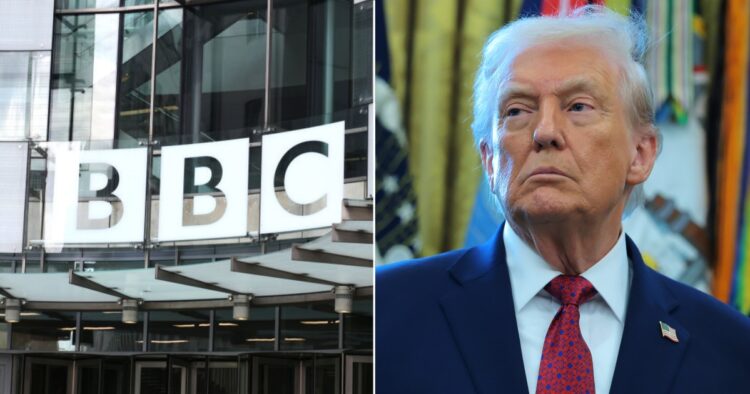
Donald Trump’s defamation lawsuit against the BBC will go ahead, but another of his claims against the broadcaster has been thrown out by a judge.
The US president is suing the BBC for $10 billion over how video clips of one of his speeches were edited together in a Panorama documentary.
The editing made it appear that Trump had urged his supporters to storm the US Capitol on 6 January, 2021.
Trump accused the broadcaster of defamation and of violating Florida’s Deceptive and Unfair Trade Practices Act, according to court documents filed in Florida.
Whilst the BBC apologised for the way the programme was edited and admitted it was misleading, they made clear they would fight Trump’s accusations.
Judge rules case will go ahead, despite BBC’s argument
The broadcaster had sought to have the case dismissed, arguing that the programme does not meet the legal criteria for defamation and was not available to view in the US.
The BBC argued the programme could not have had any material impact on the 2024 election, which is one of the main cruxes of Trump’s argument in the case.
But on Tuesday, US District Judge Jeffrey Kuntz ruled that the case will go ahead, saying that the president had plausibly alleged that the broadcaster damaged his reputation and knew, or should have known, that the clip was misleading.
However, Judge Kuntz dismissed Trump’s claims that the BBC had violated Florida’s Deceptive and Unfair Trade Practices Act, ruling that the documentary did not constitute commercial speech.
Trump has said the judge’s decision is a “huge victory,” writing in a post on Truth Social: “We will continue fighting against, and defeating, all of those who try to deceive the American People!”
A BBC spokesperson said the broadcaster is “surprised” by the judge’s decision to allow the defamation case to proceed but that it would “respect the Court’s authority.”
The spokesperson added: “We remain confident in our position and will continue to respond through the proper legal process.”
Judge Kuntz’s decision was not a ruling on the merits of the case, and he said Trump would still have to prove his case in court.
“Whether President Trump can prove these claims and establish he sustained damages at summary judgment or trial is left for another day,” he wrote in Tuesday’s order.
A provisional start date for the two-week trial has been set for February 15 next year.
Before then, Trump has been ordered to answer questions under oath in the lawsuit by 11 December, having previously swerved a deposition.
Why is Trump suing over a Panorama programme?
In the run-up to the 2024 presidential election, the BBC broadcast Trump: A Second Chance?, an episode of its Panorama series.
The contentious piece of editing which is under scrutiny came in the documentary when Trump addressed a crowd at the US Capitol on January 6 2021, before the riots broke out.
The words which Panorama broadcast were: “We’re going to walk down to the Capitol… and I’ll be there with you. And we fight. We fight like hell.”
However, the full, unedited footage shows that Trump actually said: “We’re going to walk down to the Capitol, and we’re going to cheer on our brave senators and congressmen and women.”
And then, more than 50 minutes later in the speech, he said: “And we fight. We fight like hell.”
He claimed the documentary was “false, defamatory, deceptive, disparaging, inflammatory and malicious,” and its airing a week before the 2024 election was a “brazen attempt to influence the election’s outcome.”
The trial is in the discovery phase, where both parties must turn over documents and information. The BBC has tried to extract as much information from Trump as possible to examine what damage, if any, was done to him as a result of the documentary.
Funnily enough, Trump hasn’t been particularly keen to comply with these requests.
The BBC has also asked for permission to subpoena Trump’s children as they may have relevant knowledge of the events surrounding his January 6 speech. These attempts to serve subpoenas have encountered obstacles.