


Things are starting to feel rather 1982 again on planet Earth – Israel has been invading Lebanon, technology is once again breaching the boundaries of science-fiction, oil prices are through the roof and Michael Jackson is still in the headlines.
People often say history is cyclical, and when the Falklands War happened in 1982 and the British saw off the Argentinians after 74 days, many probably weren’t too convinced the Argentinians were never going to come to back for seconds one day.
Well, following a speech given by Argentinian President Javier Milei this week addressed to the entire nation, tensions are once again rising.

What did Milei say?
In his speech, which took place at 1am BST on Friday morning (9pm local time Thursday evening), Milei reiterated previous and unwavering claims to the Falkland Islands.
He opened his speech by claiming that the Falklands “are Argentinian… historically and legally”.
“There can be no argument. They are part of the Argentine territory,” he added.
This, of course, is news to nobody, as the Argentinians have been claiming the islands since their independence from Spain, although this is still predated by the first British settlement on the islands.
However, what feels different is the actual course of action being taken by Milei against the Falklands.
While Argentina have protested oil exploration around the islands since the 2010s, Milei announced in his speech that a response to “unilateral actions on the territory” taken by the UK would be necessary.
Milei referenced a 50-year old call from the United Nations to not undertake “unilateral actions” on the territory which he says is being violated by plans to start drilling for oil.
He referenced the Sea Lion project, an oil field off the coast of the Falklands led by Rockhopper Exploration, a British firm, and Navitas, an Israeli company which he said is due to begin in the coming months.
The Falklands possess a huge amount of oil, with the Sea Lion oil field – which is owned by these companies – containing 1.7 billion barrels of oil.
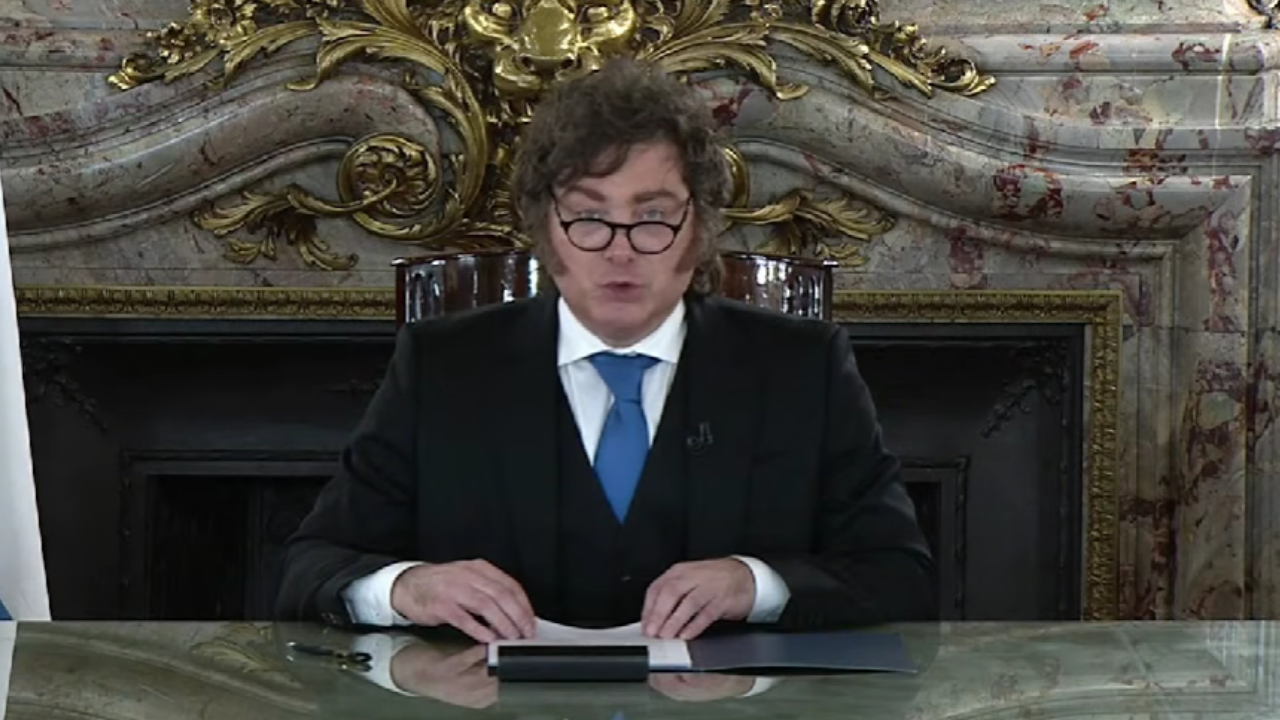
Milei said: “If we do not act swiftly in a few months, they will have the material capacity to access the oil that lies underneath our sea. Something that has never happened before.
“That means that our national claim is facing a clear and present danger, and requires a proportional response. We will not allow it.”
The Argentinian president concluded his speech by claiming that his nation needs to “recover these islands which are nationally relevant.”
He added: “There is no other path forward. It is the best way of paying tribute to those who sacrificed their lives for this cause. It is our obligation as a nation to honour their memory.”
What is a ‘proportional response’?
Well, for most nations these days, a proportional response means economic sanctions on imports, exports or nationally relevant companies – for example how Europe has responded to Russia.
However, the UK and Argentina don’t actually have strong economic ties, and any sanctions would barely put a dent in the British economy.
Of course, Milei spoke of sanctioning these oil companies themselves, however, this would also prove ineffective as the nation has no jurisdiction over the islands, so could only outlaw these companies in Argentina.
However, just like in 1982, there remains one key factor that could sway Argentina into more vigorous action – the United States.
Could we be heading for a Second Falklands War?
While nobody ever wants a war, it does seem like a possible option for Argentina.
As mentioned, economic sanctions would prove fruitless, so this leaves the South American nation with direct action as their only real chance if they are serious about “recovering the islands”.
However, the real hope for the Argentinians lies, as in 1982, with the United States. While in the Falklands War, the US had warned Argentina not to invade the Falklands, they did not get involved and took a role of mediation.
This was because Argentina was one of the few non-socialist nations in South America at the time, so saw them important in their Cold War efforts against the Soviet Union and communism.
However, this time round, the US appears to also be ready to let an invasion slide, but not on the grounds of political ideology, but oil and spite.
It has already been rumoured that Argentina could strike a deal with Donald Trump to not get involved in a potential invasion in return for access to the Sea Lion oil field.
While this remains merely talk, Trump has already come out and suggested he would not help the UK in the case of an invasion.
The US president suggested he would not back the UK if Argentina threatened the Falkland Islands, because the UK was “not there to help me” in Iran.
This week, Trump said he was ‘reviewing’ the US’s position on the Falklands, which has always been a neutral one. The US president has suggested he would not support the UK in a dispute over the islands, as revenge for the lack of support he received for his war with Iran.
Speaking to GB News on Thursday, Trump was asked if he would “come to the aid” of the UK over the islands.
He replied: “Well look, I was there when they had the first war. That was a long time ago, and I watched it so carefully, and you comported yourselves very well.
“You took it back pretty strongly, but it’s a long way away. That’s a big trip, it’s a long way.”
“So, your country’s not doing well. Don’t forget, you get a big percentage of your oil from the Strait of Hormuz, and you weren’t there to help me,” Trump continued.
“Your country was not there to help me. We didn’t need help, but I did ask Nato, and I asked your former leader, ‘why didn’t you send a couple of ships?’
“He said we don’t have any, and it was pretty sad, the whole thing.
He added: “So Nato was not there, even though they get – most of those countries get – a big portion of their oil from there. So we’re doing that by ourselves.”
How does Argentina perceive the UK and its military?
It would be unfair to say that Milei is unpopular in Argentina. A fairer word would be divisive.
As per the Buenos Aires Times, the president’s popularity has fluctuated in recent months, but sits around 40% approval and Sky News’ Mark Stone says Milei’s economic plans in Argentina are starting to work.
However, as we saw with Leopoldo Galtieri in 1982, the distraction of the Falklands and the sense of nation unity it can bring to the Argentinian people is enough to boost the popularity of a leader – until it all falls apart.
Furthermore, Stone says that Argentina has picked up on a number of economic and military “crises” in the UK in recent months, suggesting that they believe the British military could be too weak to win again in the Falklands.
Now, you do get the feeling you’ve heard that one before.
Last time it happened though, it got Margaret Thatcher two more terms as prime minister…
Ultimately time will tell if Argentina do push the big red button of war, but we can only hope that a solution can be brought about through diplomacy rather than violence.