

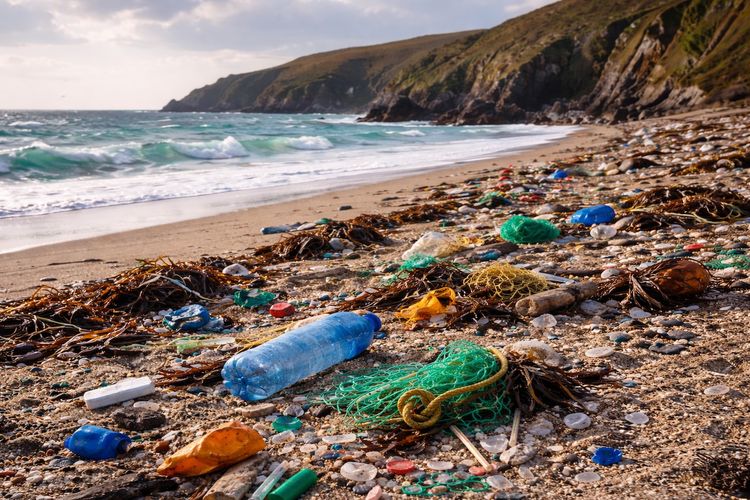
Cornwall’s beaches still look beautiful from a distance. But walk the tideline after a storm, or look closely at the wrack line where seaweed gathers, and a different story emerges – one of fragments, fibres, plastic bottles, crisp packets, and broken objects that were never meant to be here, yet now define the modern coastline.
Plastic pollution in Cornwall is no longer sporadic or seasonal. Locals describe it as constant, cumulative and accelerating. Each tide doesn’t just bring new waste – it grinds what’s already there into smaller and smaller pieces, embedding it deeper into sand, rock pools and the food chain.
This isn’t just plastic from far-off places. A growing proportion comes from much closer to home as attitudes towards littering from both visitors and residents, appears to be deteriorating. In fact, this is a picture reported all across the UK. Walk along any road and I challenge you to go 10 metres without finding some kind of plastic litter or debris. In many places, littering is simply out of control.
From our streets to the sea
The problem for Cornwall is that when it rains heavily, Cornwall’s drains and rivers act as fast lanes to the ocean. Litter dropped on streets, in car parks, outside takeaways or near schools doesn’t disappear when it’s swept away – it travels, always towards the sea.
Plastic packaging, bottle tops, cigarette filters, dog poo bags, wet wipes and food wrappers are washed (and often deliberately pushed) into road drains, gullies, streams and rivers, eventually spilling out along the coast. Once there, they are joined by fishing gear, industrial plastics and fragments carried on Atlantic currents from across the UK and Europe.
What makes the problem especially alarming is the speed of the build up. Plastic doesn’t just arrive – it multiplies.
Places that recorded little plastic 10-20 years ago, now require daily cleanups. Whats more, a single crate smashed on rocks becomes hundreds of shards. A bottle degraded by UV and wave action becomes thousands of microplastic fragments. Those fragments are then eaten by plankton, shellfish and fish, working their way up the food web.
For people who live and work on the coast, the change has been stark.
“In the ’80s it was sewage that worried us,” says Matt KNOTT, a lifelong Cornish surfer. “Plastic didn’t really show up until the late ’90s. Since then it’s been like a tap that never got turned off.”
Anybody visiting beaches in Cornwall who thinks they are still relatively clean will not be aware of the scores, sometimes hundreds, of local volunteers removing plastic from the beaches each day.
Ollie McAninch, who runs COT VALLEY Hostel on the South West Coast Path near Land’s End says “Every local person I know who is involved in regular beach cleaning is becoming disheartened due to the ever increasing amounts of plastic waste washing up each day. It feels like we have our finger in the dam, and there has been no action by any government.”
Government Inaction
You may not be aware that a Global Plastics Treaty was intended to be the world’s first legally binding international agreement to tackle plastic pollution by addressing the full life-cycle of plastics — from design and production through to disposal — and setting targets to reduce production of virgin plastics and phase out harmful additives.
However, negotiations, led by the United Nations between 2022 and 2025 and involving representatives from over 180 countries, failed to produce a final treaty. Most recently, talks in 2025 collapsed without agreement after a bloc of oil-producing and petrochemical-aligned nations, including the United States and Saudi Arabia, opposed caps on plastic production and resisted upstream regulation.
The UK has attempted to reduce plastic litter by rolling out a Deposit Return Scheme (DRS) – to cut litter by adding a refundable deposit to drinks containers. However, it has faced repeated delays, largely due to lobbying from oil, packaging and processed food interests. It is now scheduled to launch on 1 October 2027. The scheme aims to incentivise people to return containers rather than drop them as litter.
Research suggests that similar schemes can reduce container-related litter by around 70–80 % and dramatically boost recycling quality and rates. Keep Britain Tidy has estimated that tens of billions of bottles and cans could be littered between now and the scheme’s start because of the delays, underscoring the urgency of implementation.
There is fear from environmentalists that any further delays could result in the scheme being scrapped all together if Reform get into power, since they pledge to scrap many environmental laws and protections. Reform’s billionaire party funding, coupled with their closeness to the US’s oil backed executive, intimates this could be a genuine concern.
A crisis you can’t unsee
Matt is the founder of One Blue Eye, which is trying to tackle the plastic problem on a local level, but his story begins long before any workshop existed. Like many surfers, he saw the pollution before most people did – floating past line-ups, snagged on reefs, tangled in kelp.
What’s changed is scale.
Beach cleans that once filled a single bag now produce piles. Storms don’t “wash the beach clean” – they often deliver a fresh layer of debris. And increasingly, much of what’s found is unrecognisable: degraded plastic that has already broken down, but will never truly disappear.
Scientists warn that this breakdown doesn’t mean safety. Microplastics persist for centuries, absorbing toxins and entering living systems. Cornwall’s wildlife – seabirds, seals, fish – is already ingesting plastic in measurable quantities.
And humans are not separate from this system. Plastic is now found in human organs in increasing volumes.

When waste becomes unavoidable
It was during the pandemic that Matt stopped being able to ignore the problem.
“I did a beach clean and instead of throwing it away, I brought it home,” he says. “That’s when I started asking questions.”
Those questions led him to Precious Plastic, an open-source global movement designed to give communities tools to deal with plastic waste locally. What followed was experimentation – melting recovered plastic using household equipment, learning what could be reused and what couldn’t.
But the motivation wasn’t novelty.
“I take plastic waste and turn it into something that has value,” Matt says, “so people see it differently. Because right now, we treat it like it’s invisible.”
Symptoms of a much bigger problem
Even Matt is careful not to present recycling as a solution in itself.
“I’m not trying to say all plastic can be reused – it can’t,” he says. “This is about awareness.”
Much of the plastic recovered from Cornwall’s beaches is already too degraded to be recycled. Sunlight, salt and abrasion change its chemical structure. Some of it will only ever be landfill or incineration – if it’s collected at all.
That reality is uncomfortable, but important.
The pollution crisis isn’t caused by a lack of creativity at the end of the chain. It starts at the beginning: overproduction, single-use design, and a culture of convenience that externalises harm to places like Cornwall’s coastline.
“We need to turn off the tap for single-use plastic,” Matt says. “Otherwise we’re just bailing water out of a sinking boat.”
Why Cornwall feels it first
Cornwall’s geography makes it particularly vulnerable. As a long peninsula exposed to Atlantic currents, it collects waste from shipping lanes, fisheries and distant coastlines. But it also reflects national behaviour.
What’s dropped inland doesn’t stay inland.
Every takeaway container left on a pavement, every plastic wrapper tossed into a hedge, has a plausible route to the sea. The pollution crisis isn’t just a coastal issue – it’s a mirror held up to everyday life.

Small actions, heavy truths
Through workshops, beach cleans and making objects from recovered plastic, Matt tries to make the problem tangible.
One of his most striking projects was creating trophies for the Arc of Attrition, a brutal 100-mile race around Cornwall. Each trophy contained plastic collected locally.
“There’s a story in that plastic,” he says. “It came from here. It affected this place.”
For Matt, the goal isn’t to scale endlessly or industrialise the process. It’s to show what’s happening – and how fast.
“This isn’t about guilt. It’s about seeing the reality. Once you see it, you can’t unsee it.”
Cornwall’s plastic crisis didn’t arrive overnight, but it is accelerating. And while one workshop in Helston won’t solve it, it stands as a quiet reminder: the waste didn’t appear by accident – and it won’t disappear unless something changes.
If you want to be part of that change, you can support Matt on his mission. He’s running a crowdfunder aimed at empowering more people to take action through community recycling, scaling up with larger machines and creating more inspiring, high-impact products.

Matt Nott – Image by Caitlin at Hummingbird Photography