


The days of waiting nearly an hour for a video game update could soon be numbered, as a new Broadband Speed League reveals just how dramatically Britain’s fastest internet connections can cut download times.
With households increasingly relying on broadband for everything from working remotely to streaming films and downloading blockbuster games, the difference between an average connection and the fastest broadband available in the UK is becoming increasingly stark.
New figures released by Sky show that its 5Gbps Full Fibre Gigafast+ broadband can theoretically download a massive 100GB Call of Duty update in just two minutes and 40 seconds, compared with almost 47 minutes on the UK’s average broadband connection.
And it’s not just gamers who stand to benefit. According to Sky’s Broadband Speed League, a 10-episode television series in 4K could be downloaded in less than two minutes, while a full-length 4K film could be ready in just 24 seconds.
The figures come as Sky expands its Full Fibre offering, launching a new 1.6Gbps broadband package available to nearly four in five UK homes, while its top-end 5Gbps service is available to around 14 per cent of households.
Broadband Speed League: How fast is Sky’s 5Gbps internet?
Sky’s new Broadband Speed League compares how long everyday online activities could take using its fastest 5Gbps connection against the UK’s average broadband download speed of 285Mbps, as reported in Ofcom’s 2025 Connected Nations Report.
The results highlight the potential difference faster broadband can make, particularly for households regularly downloading large files, streaming high-definition content or juggling multiple connected devices.
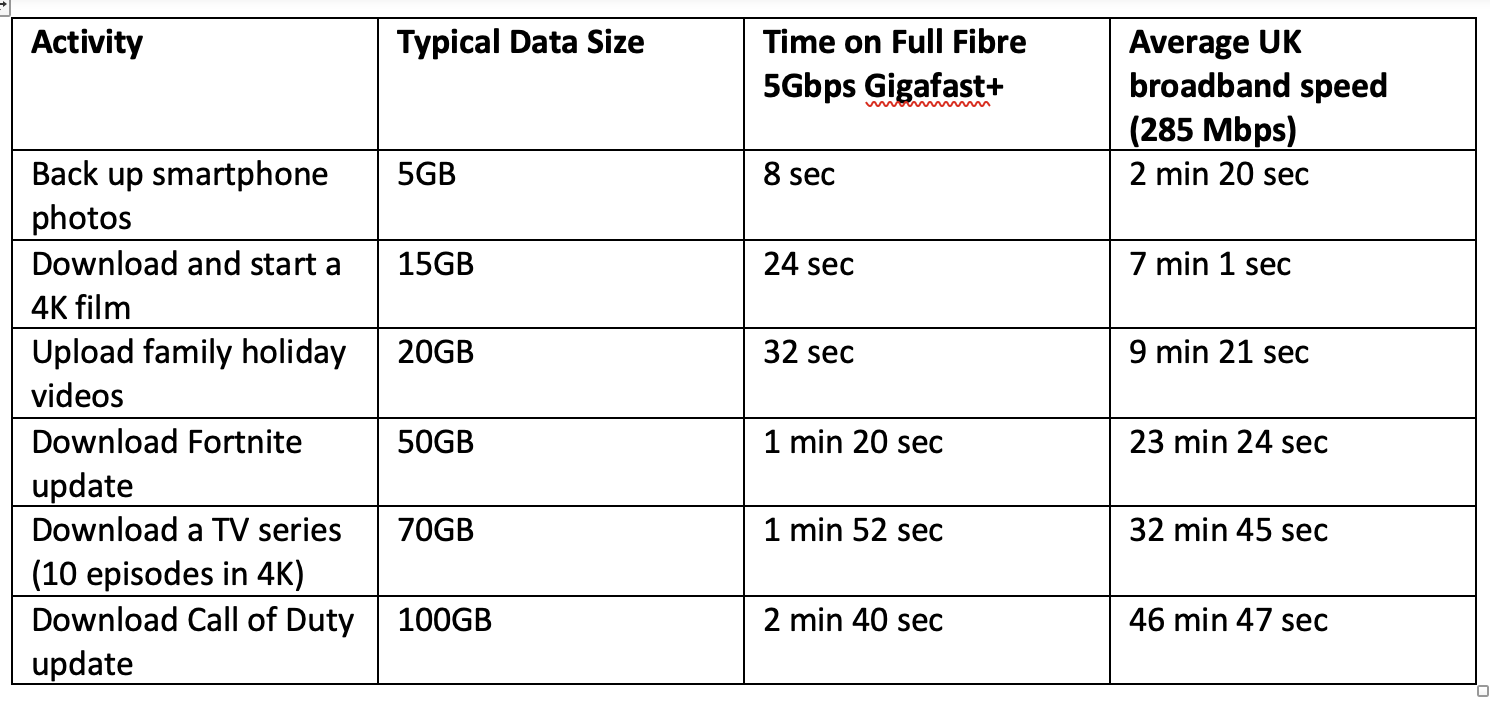
Source: Sky Broadband Speed League. Indicative transfer times calculated using 5Gbps and 285Mbps connection speeds under ideal, consistent conditions. Actual performance will vary.
Perhaps the most striking comparison is the time it takes to download a major video game update.
For gamers using an average UK broadband connection, a 100GB Call of Duty update could mean waiting almost 47 minutes before playing. On Sky’s 5Gbps connection, that theoretical wait falls to less than three minutes.
Similarly, downloading a 4K film could take just 24 seconds rather than seven minutes, while backing up 5GB of smartphone photos could be completed in eight seconds.
These are calculated estimates rather than measured real-world results, however, and actual speeds will depend on factors including device capabilities, Wi-Fi performance and network conditions.
Who offers the fastest broadband in the UK?
For households searching for the fastest broadband in the UK, Sky’s Full Fibre 5Gbps Gigafast+ package is among the highest-speed residential broadband options, offering advertised speeds of up to 5,000Mbps.
That’s roughly 17.5 times the UK’s average broadband download speed of 285Mbps.
However, access to ultra-fast broadband remains dependent on where you live. Sky says its 5Gbps service is currently available to 14 per cent of UK homes, meaning most households cannot yet access its fastest package.
Other providers also offer multi-gigabit broadband in selected areas, so the fastest available provider will depend on an individual property’s coverage.
For more households, Sky’s newly launched Full Fibre 1.6Gbps package represents a more widely available option, with the company saying it can reach 79 per cent of UK homes.
Slow broadband is still disrupting working life
The Speed League arrives against a backdrop of continued frustration with unreliable home internet connections.
New research commissioned by Sky found that British workers apologise for broadband problems on work calls almost twice a week on average.
More than two in five workers (42 per cent) said the phrase “Sorry, my Wi-Fi is playing up” had become a regular part of their working week.
Almost half (46 per cent) reported having to turn off their camera during a virtual work call to keep their connection stable.
And the consequences go beyond minor embarrassment.
Among those affected, 34 per cent said they had missed something being shared on screen, 27 per cent had missed important instructions and one in five had missed decisions being made.
More than half (52 per cent) said they had needed colleagues to repeat information or send follow-up notes because of poor connectivity.
The findings suggest that, despite the arrival of increasingly powerful broadband packages, reliable internet remains a challenge for many households.
Faster broadband for Britain’s increasingly connected homes
The demand for faster connections is also being driven by the growing number of devices competing for bandwidth.
Sky’s research found that more than half of households (53 per cent) regularly have at least five devices connected to their broadband simultaneously, with the average home running more than six connected devices.
Meanwhile, slow connections are disrupting people’s personal lives as well as their working days.
Nearly two-thirds (63 per cent) of respondents had experienced freezing screens or dropped connections while catching up with friends and family, while 34 per cent had apologised for their internet during a personal video call in the previous month.
Younger internet users appear particularly impatient with buffering. Nine in ten Gen Z respondents said they had abandoned content altogether when freezing, buffering or dropped connections got in the way.
Ben Case, Managing Director of Connectivity at Sky, said:
“Our research shows how unreliable broadband can disrupt everything from work meetings to calls with loved ones, which is why Sky Broadband is now bringing lightning-fast Full Fibre 1.6Gbps speeds to nearly 80% of homes in the UK – helping customers stay connected to what matters most.”
How much does Sky’s fastest broadband cost?
While Sky’s 5Gbps Gigafast+ service sits at the top of its broadband speed range, the company’s latest expansion focuses on bringing 1.6Gbps connections to a much wider audience.
The new Full Fibre 1.6Gbps package is available to eligible new Sky Broadband customers for £38 per month, including those who already subscribe to Sky TV, mobile or smart home services.
The package offers average download speeds of 1.6Gbps and upload speeds of 100Mbps, with Sky saying it is more than 20 times faster than its standard 67Mbps part-fibre broadband.
It also comes with Sky’s Gigafast+ hub, which supports Wi-Fi 7 technology.
Existing Sky Broadband customers will be able to upgrade at a later date, while the company is offering qualifying switchers up to £200 in credit towards leaving fees charged by their current provider.
Is 5Gbps broadband worth it?
For most households, a 5Gbps connection will offer considerably more capacity than is needed for everyday browsing, video calls and streaming.
But for gamers regularly downloading large updates, households transferring substantial files or families with multiple people using demanding online services simultaneously, the appeal of multi-gigabit broadband is clear.
It’s also worth distinguishing broadband speed from Wi-Fi reliability. A faster internet package won’t necessarily eliminate dead spots, interference or poor wireless coverage around the home.
And while Sky’s Speed League illustrates the theoretical potential of 5Gbps broadband, achieving those speeds in practice requires compatible equipment and suitable network conditions.
Nevertheless, as the UK’s broadband infrastructure continues to improve, the idea of downloading an entire television series in less time than it takes to make a cup of tea may become increasingly realistic for more households.
For now, the fastest broadband in the UK remains a postcode lottery – but Sky’s Speed League provides a glimpse of just how quickly internet downloads could become.