

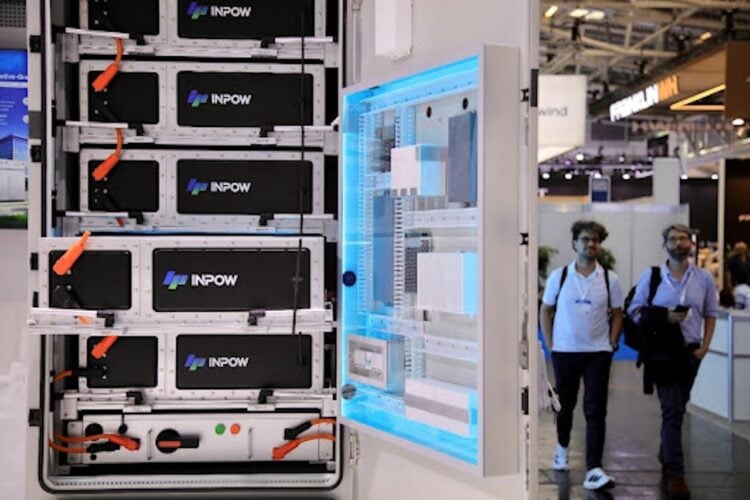
Yet a new category of competitors is emerging — battery manufacturers that originate not from the storage sector, but from the automotive industry itself.
Chinese battery company INPOW, a wholly owned subsidiary of GAC Group, used Intersolar Europe 2026 as its first major international debut, positioning itself not merely as another battery supplier, but as an example of a broader industry trend: the convergence of electric mobility and stationary energy storage.
The automotive DNA advantage
Energy storage is entering a new phase.
For years, the industry focused primarily on reducing costs and increasing energy density. Today, however, project developers, insurers and regulators are increasingly focused on another issue: safety.
The rapid deployment of utility-scale battery systems across Europe has brought growing scrutiny over thermal runaway risks, fire protection standards and long-term operational reliability.
This shift favors companies with deep experience in automotive-grade battery engineering.
Unlike traditional ESS suppliers, automotive battery manufacturers must design products capable of surviving vibration, collisions, temperature extremes and demanding duty cycles over many years. The engineering culture required for passenger vehicle safety is arguably more stringent than that of conventional stationary storage.
Tesla demonstrated this transition with Megapack. BYD followed a similar path by extending Blade Battery technology into energy storage. INPOW appears to be pursuing the same logic.
The company’s manufacturing system reportedly incorporates more than 3,000 CCD cameras and over 1,000 AI-driven inspection scenarios, reducing defect rates from parts-per-million to parts-per-billion levels. Such quality-control standards originate from automotive production rather than traditional storage manufacturing.
Europe is no longer buying batteries alone
The European storage market is also changing in another important way.
Five years ago, buyers primarily evaluated battery price.
Today, they increasingly evaluate supply-chain resilience, local technical support, cybersecurity compliance, ESG credentials, total cost of ownership, and long-term operational risk.
In this environment, technology alone is insufficient.
INPOW’s announcement that it plans to establish a European sales and technical service center reflects a wider industry reality: Chinese battery suppliers can no longer compete solely through manufacturing scale. To succeed in Europe, they must localize services, support and compliance capabilities.
The next competitive frontier: safety rather than price
The battery industry has spent years pursuing lower costs.
However, the economics of storage are changing.
As project sizes increase into hundreds of megawatt-hours and gigawatt-hours, the financial impact of a single safety incident can far outweigh savings achieved through lower battery prices.
This may explain why many manufacturers are investing heavily in advanced chemistries, thermal management systems and predictive safety software.
The industry’s next major competition may not be centered on who can produce the cheapest battery.
Instead, it may revolve around who can deliver the lowest-risk battery.
That shift could create new opportunities for automotive-derived battery companies whose competitive advantages are rooted in safety engineering rather than cost leadership.
For Europe, where grid-scale storage is becoming a critical infrastructure asset, that distinction may become increasingly important over the coming decade.