

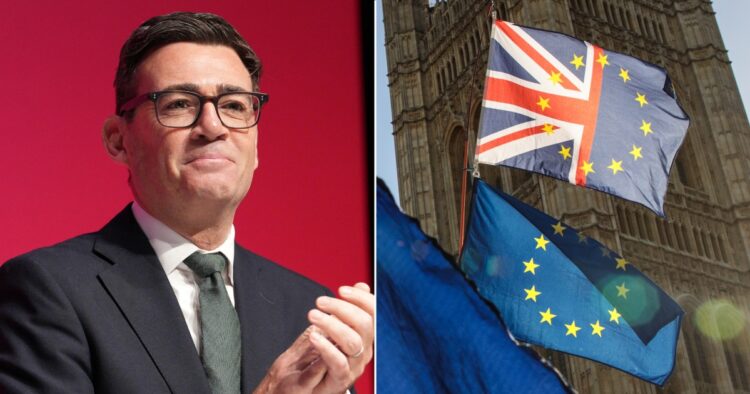
The United Kingdom and the European Union have agreed a new deal which covers food exports, youth mobility and carbon emissions.
Prime Minister Andy Burnham called Friday’s deal a “historic moment”, adding that Brits want a “better deal” with the bloc than the “hard Brexit we ended up with”.
He added that the agreement “is in tune with public opinion in the UK.”
Treasury figures estimate that the deal will provide a 0.5% boost to the UK’s GDP.
Ursula von der Leyen, President of the European Commission, also hailed the deal as a “big success”.
However, talks on student tuition fees are to continue, as per the BBC, with Burnham saying said there will be “further discussions” on the matter after Friday’s summit in Brussels.
READ NEXT: Wetherspoons boss Tim Martin says he’ll ban Burnham from his pubs if UK rejoins EU
The three core sections of a new EU-UK deal agreed today
President of the European Council, António Costa, said the EU remains open to the “closest possible relationship” with the UK.
On the other hand, von der Leyen hailed as “a big success” the agreement to scrap most checks on British food exports in return for the UK following some EU regulations.
According to PM Burnham, this will relieve pressure on the cost of living for Britons.
As he told them “this deal is for you”, Burnham confirmed that 100,000 young people will be able to spend time in “each other’s countries” to work, volunteer, study or travel, as part of youth mobility.
According to von der Leyen, negotiations have also concluded to link carbon markets to cut emissions.
This will reduce an “over-dependence on imported fossil fuels”, she added.
An agreement on migration that will crack down on Channel crossings, which is dubbed “Channel Action Plan”, was also reached Friday.
As per Burnham, the agreement would inject a £17bn boost to the UK economy and will add up to 0.5% to the UK’s GDP.
Burnam called it the “single biggest growth measure we could take in this parliament”.
The UK-EU youth mobility scheme and what it all means
As per the scheme, which was agreed by the UK and EU, people between 18 and 31 years-old will be allowed to work, study or travel in the European Union for up to three years.
This also applies vice versa for EU citizens coming to the UK.
Thanks to the scheme, 100,000 Britons and 100,000 citizens from the EU are able to participate each year.
When it comes to numbers for both those coming to and from the EU, they will be allocated between the member nations based on each country’s population.
Participants from Britian first will apply to travel to one particular country in the EU.
Later they can switch to another one, but they must spend one full year in one country before they switch.
This means that in total, they can stay in three countries during their stay which lasts three years.
While abroad, neither British nor EU citizens will be able to access benefits while abroad or be accompanied by dependants such as children.
At the same time, participants will need to pay an application fee and prove they have enough money to support themselves during their stay.