

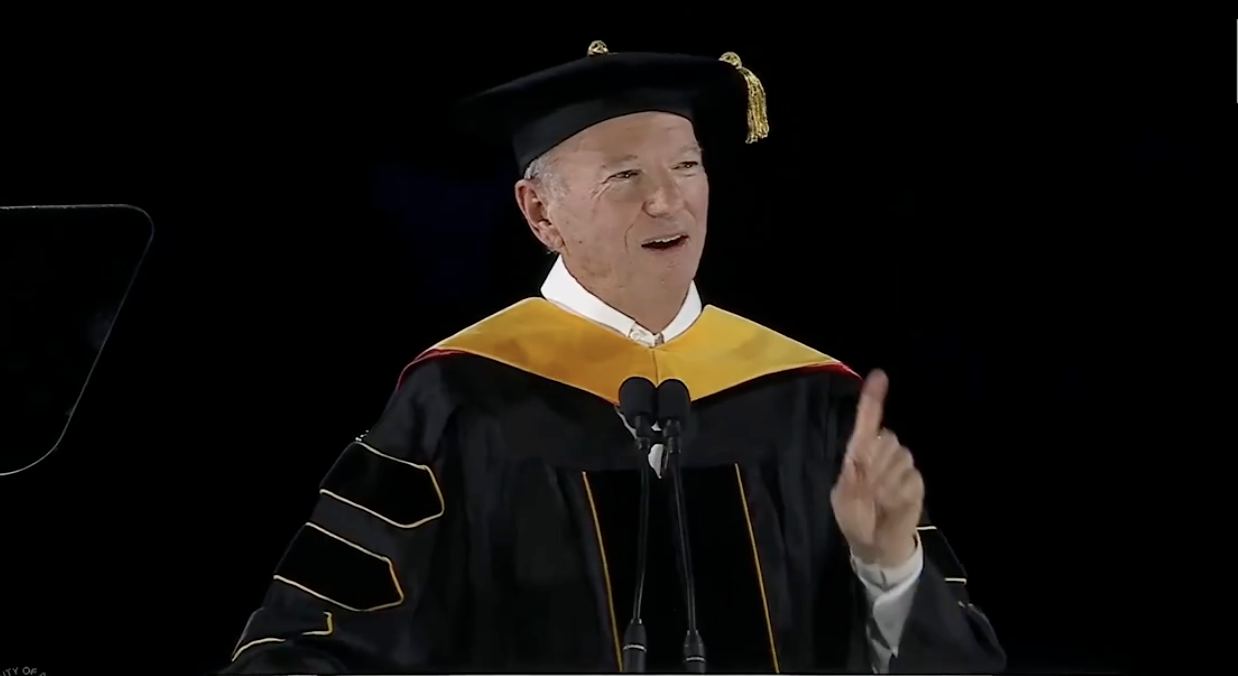
Former Google CEO Eric Schmidt was booed by a students as he tried to convince them to love artificial intelligence.
During a speech at the University of Arizona’s graduation ceremony, Schmidt spoke about how Time magazine had chosen the ‘architects of artificial intelligence’ as its Person of the Year for 2025.
He described this as “interesting,” which prompted the first murmurings of discontent from the students in attendance.
From there on in, it only got worse for Schmidt.
He continued: “It [AI] will touch every profession, every classroom, every hospital, every laboratory, every person and every relationship you have.
After saying “I know what many of you are feeling about that, I can hear you,” Schmidt had to stop mid-speech as he was drowned out by boos and jeers.
READ NEXT: Economists publish mathematical proof that AI will destroy the economy
The students made their feelings even clearer after Schmidt urged them to “choose a diversity of perspectives, including, if you’d let me make this point please…”
Schmidt went on to say that AI would “touch everything else” outside of science.
“Whatever path you choose, AI will become part of how work is done,” he said.
To an ex-tech CEO, these words probably sound beautiful and heart-warming, but to a room of graduating university students his comments went down like a cup of cold sick.
Nevertheless, the oblivious Schmidt tried to encourage the students by telling them they can “now assemble a team of AI agents to help you” solve any problem.
Again, this didn’t quite have the reaction he expected.
The speech is a clear example of the uncertainty and fear felt by many towards artificial intelligence and the impact it will have on the world.
Earlier this year, a peer-reviewed economics paper from researchers at the University of Pennsylvania’s Wharton School and Boston University delivered one of the starkest warnings yet about AI’s long-term economic impact.
Effectively, they warned that left unchecked AI-driven automation could destroy the economy, collapsing consumer capitalism itself.
You can read more about that here.