

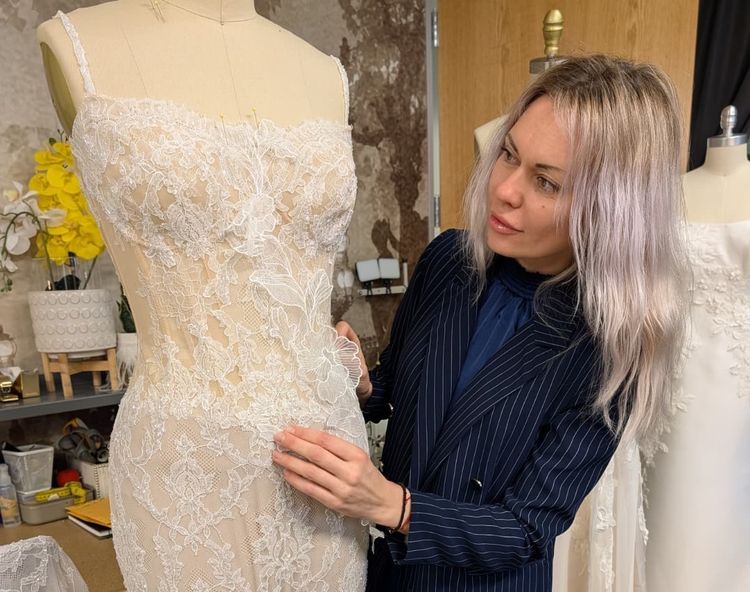
As part of our People in Business series, we speak to Tetiana Kibkalo, who is a master tailor, patternmaker, and designer with more than twenty years of experience, whose career spans from leading bridal salons and fashion houses in Ukraine to the international market.
Tetiana Kibkalo is a master tailor, patternmaker, and designer with more than twenty years of experience, whose career spans from leading bridal salons and fashion houses in Ukraine to the international market. A creator of couture ateliers, a participant and award winner of professional competitions, and a jury member of industry projects, she today shapes not only visual aesthetics but also quality standards in the luxury bridal and stagewear industry.
Tetiana, is participation in professional competitions more about recognition or about an inner test of oneself?
— For me, competitions have always been primarily a test of inner honesty toward the profession. It’s a moment when you’re alone with your own level — without clients, without personal stories, without compromises. You present work not because it was commissioned, but because you believe it is worthy.
In addition, the competitive environment shapes taste and discipline: you learn to think in concepts, not just beautiful forms. Recognition is pleasant, but secondary — the main thing is that after a competition, you emerge as a different professional.
You have served on juries of professional competitions many times. What is most important to you when evaluating other designers’ work?
— First and foremost, professional integrity. I always pay attention to the cut, fit, material handling, and construction logic. Beautiful decoration without a solid foundation is an illusion, not craftsmanship.
The second aspect is the idea. It’s important for me to understand why the garment was created, what story it tells, and for whom. And, of course, the level of handwork — this is what distinguishes true craft from mass production.
Is it difficult to be a strict judge, knowing how much effort goes into each piece?
— It truly is difficult, especially when you see dedication and ambition. But judging is a responsibility to the profession, not to emotions. If we lower standards out of sympathy, we devalue the industry itself.
I strive to be honest but constructive: criticism should help one grow, not break them. It’s important that participants leave not with resentment, but with clarity about where to move next.
How have competitions and judging influenced you as a designer?
— They taught me to look at my own work from the outside, as if it didn’t belong to me. That is very disciplining and grounding. You start asking tougher questions: is this professional enough, is every element justified, will the work withstand expert evaluation?
Judging also broadens perspective — you see where the industry is heading, which trends are truly viable and which are just momentary flashes.
You have worked in very different markets — from Ukraine to Egypt and the United States. Do standards of professionalism change depending on the country?
— The context changes, but the essence does not. In Egypt, for example, there are very high demands for stage impact and movement — garments must work dynamically and under intense lighting. In the U.S., more attention is paid to business processes, deadlines, and scalability.
But the core values remain constant: quality, precision, respect for the body and for the client. A true professional is recognizable in any country by these traits.
Today you increasingly act not only as a designer, but also as an expert. Do you feel this role?
— Yes, and it came naturally. When you have years of practice, competitions, your own ateliers, and international experience behind you, you begin to understand that you can share not only aesthetics, but knowledge.
Expertise is not about loud titles, but about the ability to explain why something works or doesn’t. And if my experience helps others avoid mistakes or build a more conscious path — then I am exactly where I should be.
What qualities today distinguish a true master from someone who is simply talented?
— Patience, structure, and respect for the profession. Talent without discipline burns out quickly. A true master understands that every stitch carries responsibility, not just inspiration.
It’s also important to be able to evolve and accept change without betraying fundamentals. Fashion changes, but craft remains — and it is craft that defines a professional’s level.
Looking to the future, what role would you like to continue playing in the industry?
— I’m close to the role of mentor and expert who helps shape a culture of quality. I want to be involved in projects that value handwork, professionalism, and a conscious approach to fashion.
Creating collections remains an important part of my life, but today I’m also interested in influencing processes — from education to business strategy. It’s a natural continuation of the path I’ve taken.