

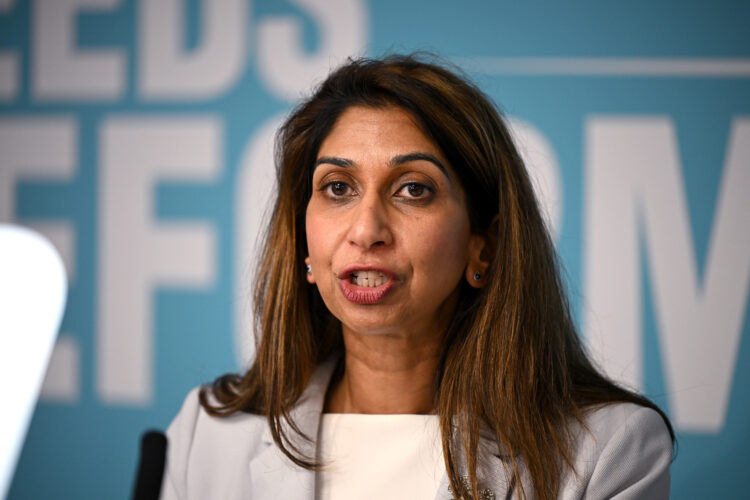
Suella Braverman has sparked controversy after declaring that she does not see herself as “English.”
The former home secretary, who last year defected from the Conservative Party to Reform, said in a post on X that she is only “proud to be British.”
“As I’ve said before, I’m not English,” Braverman wrote.
This is despite the fact the Fareham and Waterlooville MP was born and raised in London, went to university in Cambridge and now lives in Hampshire.
Her comments are the latest development in a debate that has started on the right about what it means to be English.
READ NEXT: Jacob Rees-Mogg urges Brits to ‘do their duty’ – even if some of us ‘have to die’
The discourse started after former prime minister Rishi Sunak wrote in a column in the Sunday Times in which he rejected suggestions that only white people can be English.
Sunak said: “If you are born and brought up in England and view it as home, what are you other than English?
“Attempting to deny people their Englishness or Britishness because of the colour of their skin is a recipe for alienation, for a two-tier society. How are children who hear this meant to feel?”
His words highlighted a split between more traditional right-wing voices and hard-right figures about the difference between being English and British is.
Former Tory MP Jacob Rees-Mogg shared a video on the matter, in which he said anyone can identify as English or British, no matter their ethnicity.
Responding to the video, Braverman wrote: As I’ve said before, I’m not English. I’m proud to be British. My family and ancestors have a link to Britain which spans centuries. But in no way are we English.
“Yes, I was born in England, speak English and support the England football team. And indeed, I love England and the English people. But to say I’m English is to take a ‘laissez-faire, anything-goes’ attitude to ethnicity, citizenship and identity. It also denies me my Asian heritage.
“The liberals (many of them in today’s Conservative Party) take this cosmopolitan approach to Englishness. They’re terrified of being called racist so they say that anyone, as long as they’re born here, can be English. I take the conservative approach. Englishness is an ethnicity.
“There have been English people for centuries and we need to recognise this more if we are to start taking a more muscular approach to citizenship and nationality. And no, it’s not racist to say this.
“Other countries have no qualms in limiting who can be part of their citizenry and use ethnicity and culture as criteria. Here, the dogma of multiculturalism has been so corrosive that some people don’t actually know who we are anymore.”
Her comments were met with a mix of bafflement and anger from some on social media, including from some voices on the right.
Tory MP Ben Obese-Jecty rejected Braverman’s argument and dismissed the idea that being English was a question of ethnicity.
He wrote: I am English. I’m old enough to remember when considering yourself to be English meant that broadly speaking you’d been born here, grown up here, went to school here, lived here, followed English cultural customs and to all intents and purposes, were English. It wasn’t controversial.
“Most normal people who describe themselves as English mean this, in much the same way as they would describe themselves as a Londoner, or a Mancunian or a Brummie.; They aren’t referring to their ethnicity or trying to erase yours. It’s not complicated.”
Others slammed Braverman for spouting ‘ethno-nationalist’ lines.