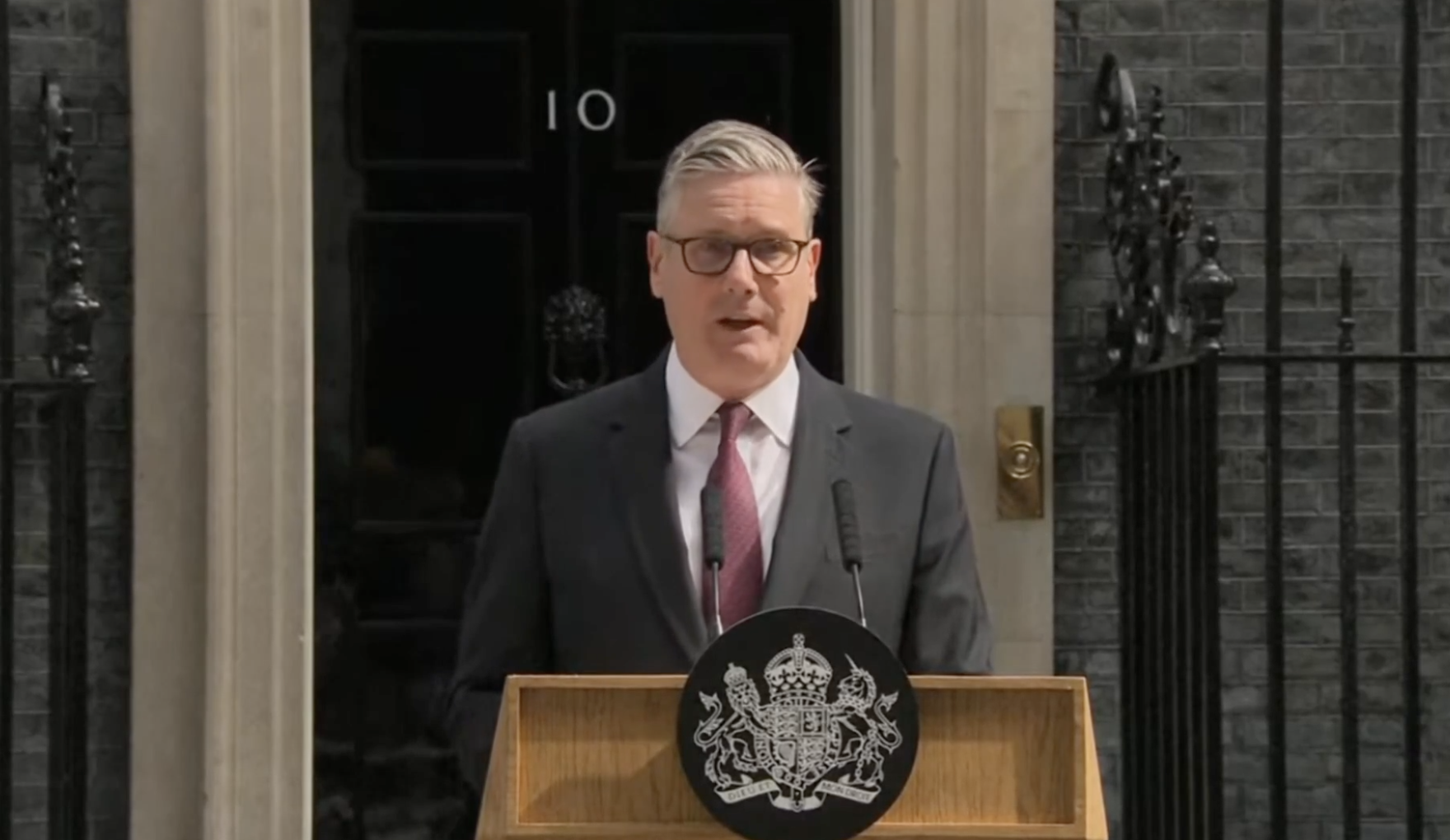
Ode to Joy was played from a loudspeaking outside Downing Street during Sir Keir Starmer’s resignation as prime minister.
In an address to the nation on Monday morning from Downing Street, Starmer gave an emotional speech in which he confirmed he would be stepping down as Labour leader.
But within seconds of Starmer beginning his speech, loud classical music could be heard in the background.
The music being played was Ode to Joy, and came from anti-Brexit campaigner Steve Bray and his loudspeaker.
Speaking on BBC News in the wake of Starmer’s resignation, Nick Robinson said it was a “bizarre spectacle” and that the music was “almost deafening.”
He said Bray was “trying to blast him [Starmer] off the airwaves.”
Reacting online, journalist Lewis Goodall branded Bray a “disgrace” for playing the music, labelling him a “yob.”
Others drew comparisons to when Bray played ‘Things Can Only Get Better’ in 2024 when Rishi Sunak announced a general election.
Ode to Joy dates back to 1785, and is an ode written by German poet, playwright, and historian Friedrich Schiller. However, it is best known nowadays for being used by Ludwig van Beethoven in his Ninth Symphony in the 1820s.
The melody used by Beethoven was then adopted by the Council of Europe in 1972 as the ‘Anthem of Europe,’ and is still used as the official anthem of the European Union.
So, given the European symbolism of the song and the anti-Brexit campaigner who was playing it, it seems this was a comment on the UK remaining outside of the EU.
Whilst Starmer and his government took significant steps since coming into power to rebuild relations with the EU, they maintained that Britain should not rejoin the trading bloc.
This has been a point of contention for some Labour figures, such as Sadiq Khan and Wes Streeting who have both called for the UK to rejoin the EU.
London Mayor Khan suggested earlier this year that Labour should make a second EU referendum part of their manifesto at the next general election, something we have previously called for.
Starmer spoke of his pride in becoming prime minister and saving Labour from ‘moral and financial bankruptcy’ when he took over.
After listing the achievements of his government, such as rebuilding British relations with the EU, wages rising higher than inflation, the economy growing, and asylum hotels closing.
But he went on to say that his party was asking “whether I am best placed to lead us into the next general election.”
He said he had heard the answer of his party and “accepts it with good grace,” before confirming he was resigning as the leader of the Labour party.
Starmer confirmed the timetable for the transition of power would be set out by the Labour national executive committee, with nominations opening for the leadership on 9 July, and completed by the summer recess.
A new leader will be in place before parliament returns in September, he said.
Starmer added his successor would get his full support.
An emotional Starmer than thanked his family, saying he was leaving the “biggest job in the country” to spend more time on “the most important job”.
“Being the best husband I can, to my fantastic wife Vic, who has been a rock by my side through good times and bad,” he said, his voice audibly breaking.
“And being the best dad that I can to my beautiful children, who are my pride and joy,” he concluded.