

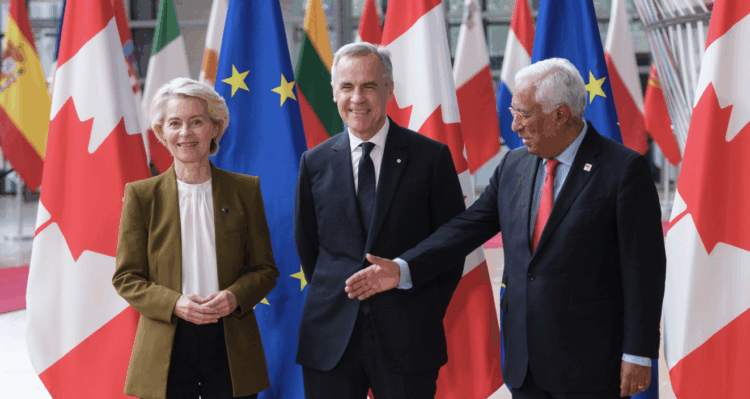
The president of the European Commission, Ursula von der Leyen, has backed plans for Canada to become the European Union’s first “associate member.”
Speaking to the European Parliament on Wednesday, von der Leyen said she wanted to work on “opening the door” for Canada.
Earlier this week, Carney had said he was seeking a “unique alliance” between Canada and the EU.
This came after the Wall Street Journal reported that EU officials were open to a suggestion that Canada could become an “associate member” of the bloc.
Now, von der Leyen has confirmed the EU is open to the idea.
She said: “I would like to work with you on opening the door for Canada to be the first associate member of the EU.”
Von der Leyen said the EU and Canada would work to create “a common prosperity and economic security space.”
She continued: “We will work on intelligent manufacturing. We will create a tech alliance. We will integrate defence industrial bases.
“We will make the Arctic a flagship joint project. We will work on energy, critical minerals and batteries, on AI, quantum, cyber and economic security.”
In a seeming reference to Trump and his administration, von der Leyen said the offer of associate member status to Canada was “not a partnership against anyone else, but for our common strength”.
She added: “Partnerships are a strategic choice for Europe. But they also respond to the fracture in the international rules-based system”.
READ NEXT: Burnham urged to ‘reverse Brexit’ – as support for rejoining the EU hits all-time high
In recent months, Carney has sought to forge a much closer trans-Atlantic relationship with Europe as their rift with the US grows under Donald Trump.
With the EU’s relationship with the White House having deteriorated as well, for similar reasons as Canada, such as tariffs and territorial threats, it would seem to be a mutually beneficial arrangement.
However, “associate membership” of the EU does not currently exist and could take years if agreed.
This week also saw Australia say they were looking to follow Canada’s lead in forging a closer relationship and alliance with the EU.