

One of the peculiarities about British cuisine is how on one hand we struggle to define it and on the other how defensive we are when foreign visitors want to try our ‘traditional’ fish and chips, as if that’s the alpha and omega of our diet. Living as we do in the country that gave the world chicken tikka masala, and in a city where a Korean supermarket sits across the road from a branch of Tesco, or a ramen restaurant next to a branch of Greggs how do you explain to both visitors and even to ourselves what is British food?
To begin with, fish and chips are not British in their origins, frying fish imported by Sephardi Jews and fried chipped potatoes a Belgian import both in the mid-19th century. So where do we draw the line? Sticky toffee pudding invented in the 1970s. Worcester sauce – an attempt to recreate an Indian sauce for an ex-Governor of Bengal. Ploughman’s lunch – invented by a Government agency in the 1950’s. Jacket potatoes – popularised in the 1970s. Fish pie – a French import; the list goes on and on. Perhaps we only reach the foundational level of what is British with ‘the roast beef of old England’.
Of course, the suet puddings, sausages, pies and other ‘standards’ through time are traditional, though they are not exclusively British. The truth is much of our cuisine is adopted and reflects our island nation history of trade, invasion, immigration and imperialism. So where to draw the line? Perhaps to accept that much of what we assume is traditional British cuisine is a social construct with some elements rooted in tradition and truth – it is simply another complex cultural construct. For sake of an argument perhaps it is best in 2026 not to think of ‘traditional’ British food and instead to consider it as part of a retro trend. A desire for the familiar and the comforting in a World which seems increasingly to lack certainty.
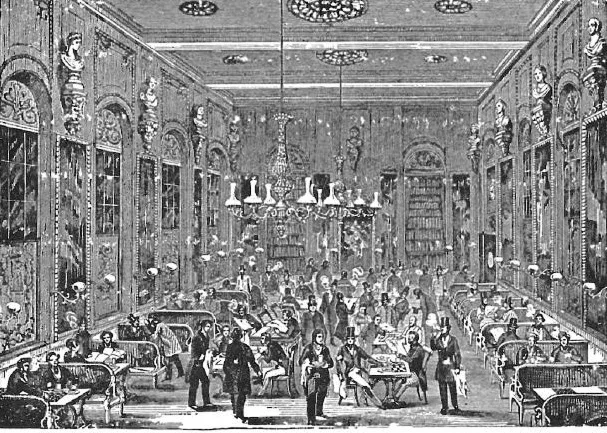
All of this brings me to Simpsons on the Strand. Even here we encounter myth, a venerable institution to British food which began life as a chess club proving history is often more peculiar than we are led to believe in Horrible Histories.
Simpsons on the Strand is one of the oldest restaurants in London. Before it closed in 2020 the restaurant had for many years been seen as a stuffy old relic trading on its past. Now the 187 year old Grande Dame has been brought back to life and relevance by one of London’s finest restauranteurs, Jeremy King (The Park and The Arlington, and before these The Ivy, Le Caprice, The Delaunay and The Wolseley).
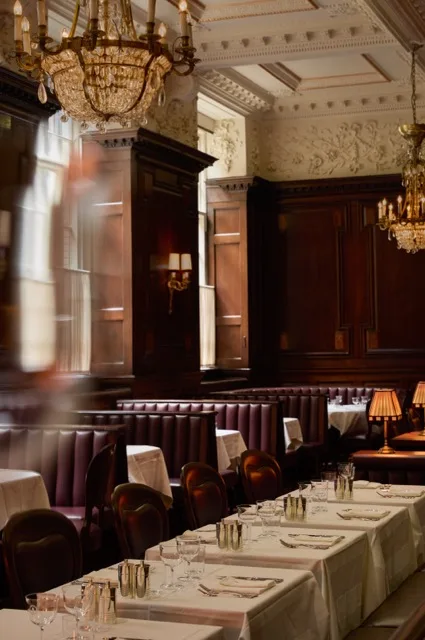
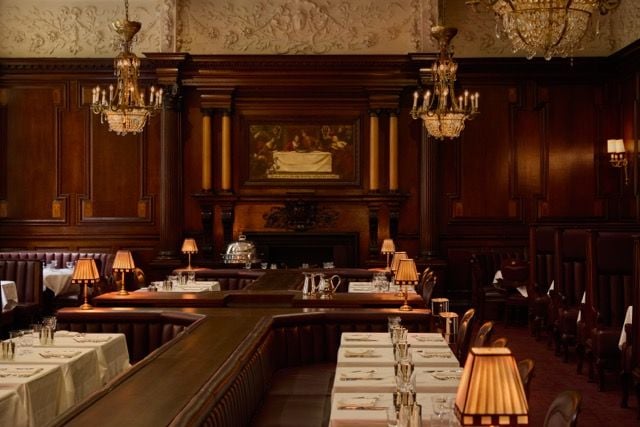
And what he has achieved here is quite simply miraculous. Clever cosmetic touches and a subtle update of the impressive interior architecture he has transformed the place by succeeding in making it both contemporary and traditional all at the same time. It exudes a sense solidity, of timelessness with an aura of a St James’s club – yet welcoming to all. The menu is true to Simpsons’ heritage, the cooking and service on my visit were both excellent, and it was a pleasure not to see a single mobile phone being used the whole time I was there – ‘influencers’ are not welcome.
One of the most appealing characteristics of the resurrected Simpsons is how it leans into its historic food offering of roasts, grills, pies and the like, to the extent that a diner from the 1930 would find the menu familiar, and yet to a modern diner it seems on trend. Simpsons is not a museum or tourist curiosity, it is a modern restaurant. Perhaps that’s because a great part of London’s appeal is its diversity. If you consider the breadth of food offerings with what used to be available, the transformation over the first quarter of this century has been extraordinary. This diversity has also given rise to the undercurrent of high quality ‘traditional’ foods on offer as chefs explore the best of the past. From the prawn cocktails and treacle puddings seemingly everywhere now to the superb pies at the Pie Hole, in Holborn and Eton mess at Quo Vadis in Soho, even the penny lick at Teal in Hackney. Though the day when coffee bars start serving mugs of Bovril alongside matcha lattes or influencers start retromaxxing we’ll know we’ve hit peak trend, and it’ll be time to lobby the BBC for the excellent Justin ‘Dustbin’ Tsang to be a judge on Master Chef.
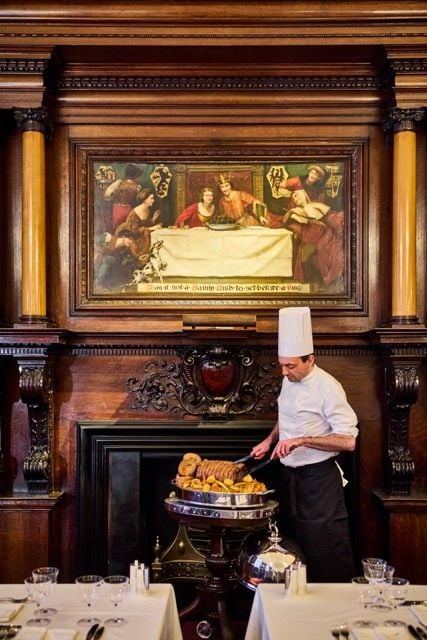
The Simpsons menu offers a wide range of traditional British dishes from pies and savoury puddings to roasts. As my lunch guests only wanted a main course, we all had the roast beef. as nothing screams Simpsons louder than a roast carved at the table from the trolly. It was a generous serving, medium rare with excellent Yorkshire puddings, glazed vegetables, potatoes, gravy and whipped horse radish. With a bottle of decent Malbec to wash it down we were all pleased with the restaurant (and ourselves).
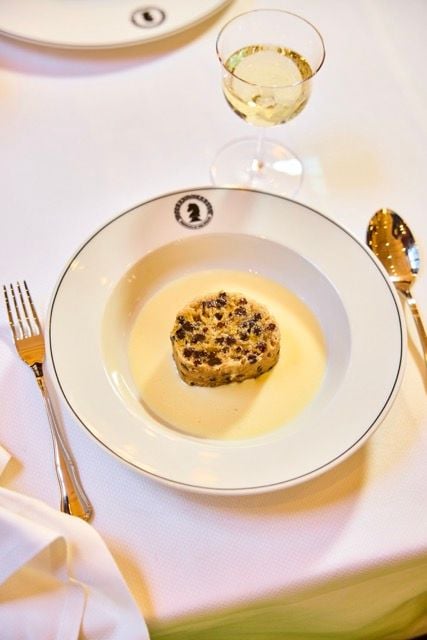
Simpsons on the Strand is back with polite British bang, the magic is by zeroing in on the traditional which is a mirage or conjuring trick as what appears traditional is in fact truly modern. This restaurant is definitely worth your attention.
Prices and details
The prices at Simpsons are pretty standard for central London, with mains from £15.75, though the roast rib from the trolly is £39.50. You could pay more elsewhere and not eat half as well.
We ate in the ground floor restaurant ‘The Grand Divan’, which is an impressive yet comfortable room all wood panelling, ornate plasterwork and leather banquettes. On the first floor is an all-day ‘European’ grand café ‘Romanos’, along with a cocktail bar ‘Simpsons’. There’s also a pre-theatre/late night basement bar ‘Nellie’s Tavern’.
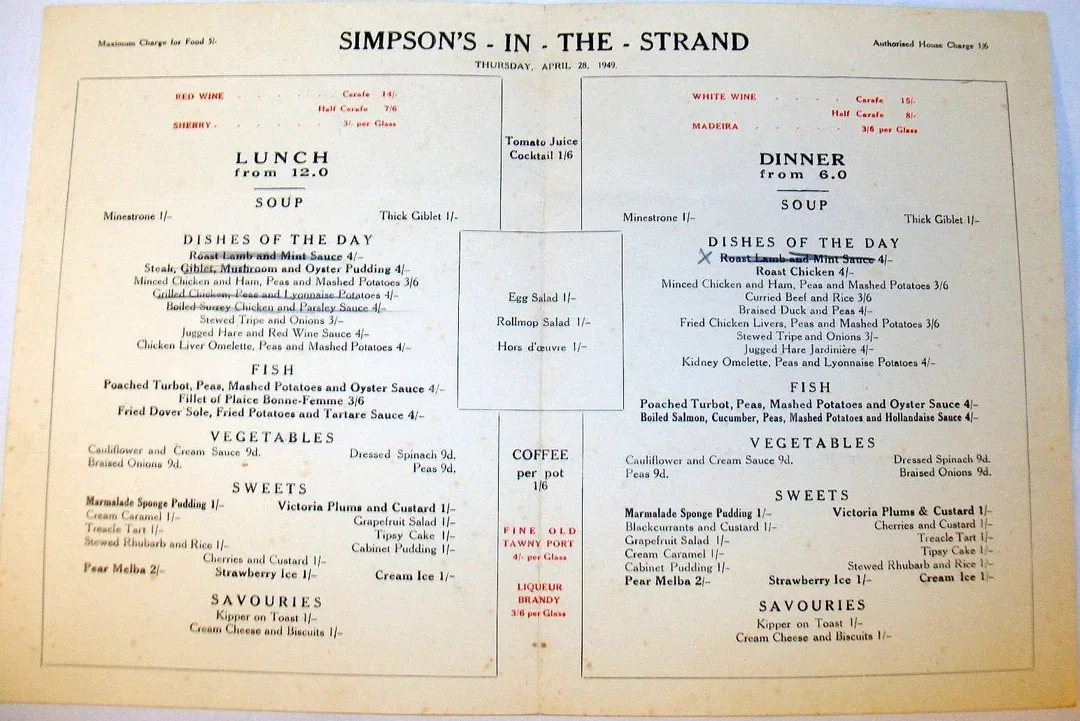
The Information
Simpsons in The Strand, 100 The Strand, London WC2R 0EZ – 020 7836 9112 – www.simpsonsinthestrand.co.uk
Reservations: Book online: www.simpsonsinthestrand.co.uk/reservations or [email protected]
The Grand Divan: [email protected]
Romano’s: [email protected]
Private events: [email protected]