

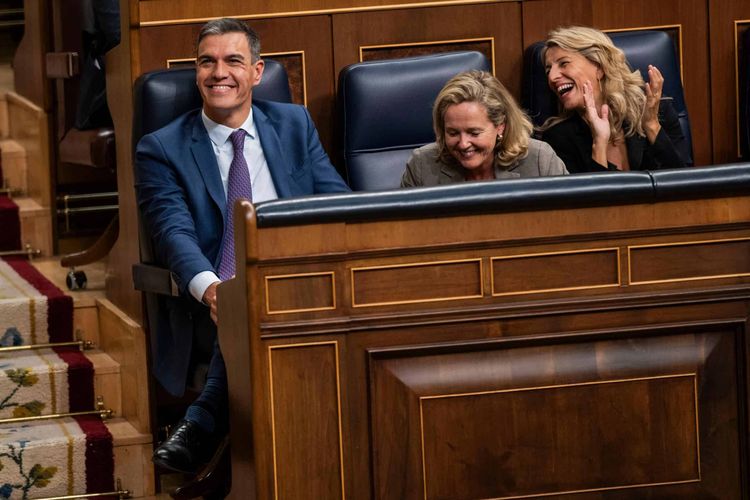
When the world’s richest men start frothing with rage at a centre-left prime minister, it’s usually a sign that something has gone badly wrong for them, and rather well for everyone else. So when Elon Musk recently branded Pedro Sánchez a “true fascist totalitarian” on X, it was worth asking a simple question: what, exactly, is Sánchez doing that so upsets the billionaire class?
The answer is disarmingly straightforward. He is governing in the interests of ordinary people, and it’s working.
Under Sánchez, Spain has quietly built what many economists now describe as Europe’s boom economy. While much of the continent has stagnated or flirted with recession, Spain has surged ahead, becoming the fastest-growing major economy in Europe. Even the suits at Goldman Sachs have been forced to acknowledge the turnaround – hardly a hotbed of left-wing romanticism.
This success hasn’t come from the familiar neoliberal playbook of wage restraint and labour “flexibility”. Quite the opposite. Since Sánchez took office, Spain’s minimum wage has risen from €736 to €1,221 – a staggering increase that has directly improved the lives of millions of low-paid workers. At the same time, his government has slashed insecure employment, cutting the proportion of workers stuck on temporary contracts from around 30 per cent to roughly 13 per cent. For years, we were told this was impossible. Spain has proved that it was simply a political choice not to try.
Migration policy tells a similar story. Instead of demonising migrants for short-term political gain, Sánchez has pursued regularisation and integration, recognising that migrants are not a threat to prosperity but a vital part of it. In a country with an ageing population and labour shortages, this has been both humane and economically rational. No surprise, then, that those who thrive on culture-war outrage are unimpressed.
Spain has also rediscovered a sense of moral clarity on the international stage. Sánchez has consistently spoken up for human rights, even when doing so is inconvenient or unpopular. And unlike so many European leaders, he has refused to abase himself before Donald Trump – a stance that seems to offend certain billionaires almost as much as higher wages for cleaners and delivery drivers.
Seen in this light, Musk’s outburst looks less like a serious political critique and more like a tantrum. To those who believe that markets should rule unchallenged and that democracy is best kept on a tight leash, Sánchez represents a dangerous idea: that governments can still shape economies in the public interest, and that doing so can deliver growth rather than kill it.
If that makes him a villain in billionaire circles, Sánchez should wear the insult as a badge of honour. When the people of Spain are seeing rising wages, more secure jobs and a thriving economy, while the world’s richest men are fuming on social media, it’s hard to escape the conclusion that Spain’s prime minister is doing something very right indeed.