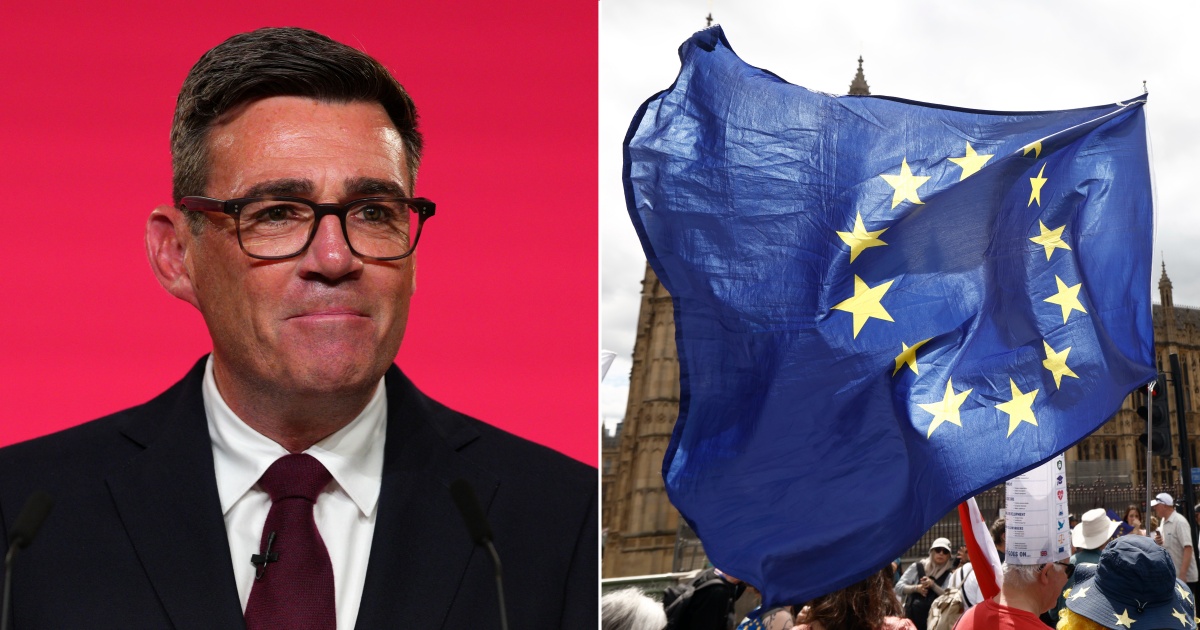
Food exporters have already welcomed Andy Burnham’s ‘Brexit reset’ deal with the European Union.
Last week, the government took a symbolic and significant step in healing relations with the EU as the UK and the trading bloc agreed a ‘Brexit reset’ deal.
The deal covered agreements on food exports, youth mobility and carbon emissions, with the Treasury estimating it could provide a 0.5% boost to the UK’s GDP.
READ NEXT: Richard Tice stunned as Burnham reminds him what Farage has said about Brexit
And whilst Brexiteers would have you believe the deal is going against the will of the 17 million people who voted for Brexit, in the real world it is already being welcomed by everyday people.
The agreement on food in particular has been seen as a significant piece of progress, as it is set to scrap a whole host of checks required on British food exports to the EU, reducing paperwork for exporters.
Speaking to the BBC, food producer Charles Douglas Baughan said the deal would make exports “accessible for all producers”.
He said the deal would give his Dveon-based sausage company “new routes to market” and put “fresh back on the table”, the UK’s departure from the EU in January 2021 had meant he was no longer able to export of fresh pork sausages or mince to Europe.
Baughan said that once the deal comes into effect on 1 March 2028, the reams of paperwork he has to fill out “would all go away.”
“I think that’s a huge step forward in making exports accessible for all producers, not just the big companies with people who can do the paperwork, but the small artisan producers here in the West Country,” he said.
Meanwhile, the founder of a company that specialises in catching and selling mussels told the BBC how Brexit had caused the “immediate cessation” of its export industry.
Nicki Holmyard, founder of Offshore Shellfish, explained that her mussels could no longer be sold to the EU after poor-quality water readings meant the produce couldn’t be accepted by the trading bloc under its rules.
“We couldn’t send them to be cleaned in the European Union and there are no facilities here,” she said. “Investors lost confidence in us because we had lost our main market, and our business was developed to export.”
Holmyard praised the new UK-EU deal, saying it would result in reducing the “massive amount of paperwork” and “all the hassles of border control”.